How Wireless Connections Work
How NFC, Bluetooth, Wi-Fi and infrared send data, and how far each one reaches
What you'll learn
- How a signal switched on and off carries ones and zeros
- How NFC payments and transit cards work at a few centimetres
- How Bluetooth pairs two devices and why it uses so little power
- How Wi-Fi connects a home to the internet, and why infrared needs a clear path
NFC, Bluetooth, Wi-Fi and infrared all send data without a cable. Each one switches a signal on and off very quickly, and the receiver reads those changes as ones and zeros that make up a message. They differ in the kind of signal they use and how far it reaches.
NFC only works when two devices are about four centimetres apart or closer. A payment terminal gives off a magnetic field, and a phone held close picks it up and answers with a one-time payment code. Transit cards have no battery, because the reader's field powers the card's chip long enough for it to reply. Bluetooth uses radio waves and links two devices directly, like a phone and earbuds, up to about ten metres apart. After you pair them once, both keep a shared key and reconnect on their own.
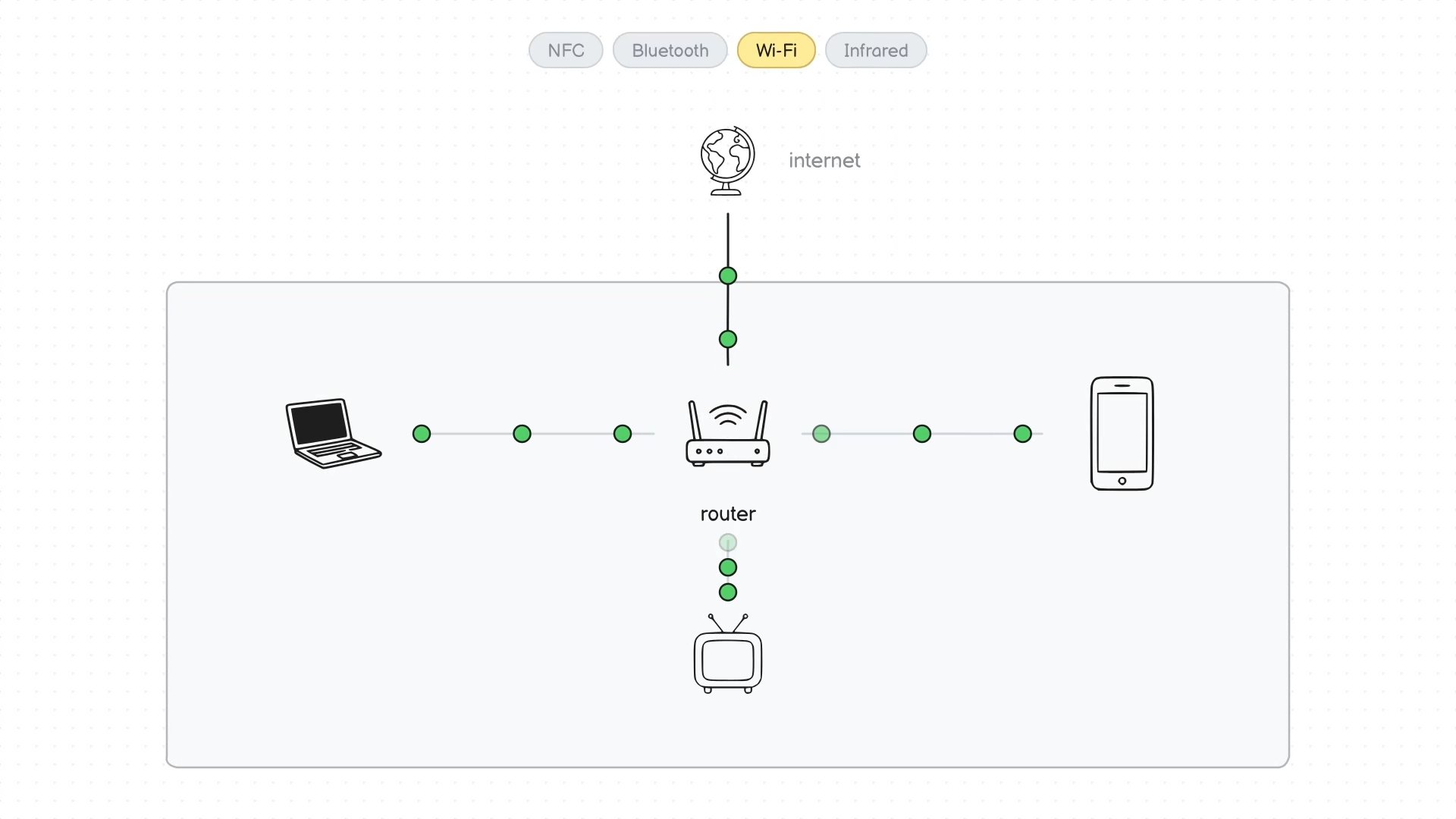
Wi-Fi also uses radio, but each device connects to a router, and the router is wired to the internet. Anyone nearby can pick up the signal, so Wi-Fi scrambles it, and only devices with the password can read it. Infrared is light just past the red we can see. A TV remote blinks it in a pattern that the TV's sensor reads as a command, so it needs a clear path and only works inside one room.