Python Backend Frameworks: How to Choose the Right One
 William Imoh
The first time I had to work on a backend project, I did not make a technical decision. I just followed the trend, something almost every developer experiences at some point.
At the time, just like me, most beginners default to whatever tutorial they find first instead of stopping to evaluate which backend architecture actually fits their project and the long-term tradeoffs that come with it. Understanding what each framework is built for, before you start, saves you from fighting battles in your codebase you did not see coming.
Django, Flask, and FastAPI each solve different problems with very different philosophies, and newer frameworks like Litestar are gaining traction for high-performance API workloads. Not dotting your i's when choosing a framework might actually cost you.
The Python Roadmap runs parallel to everything covered here if you want the full picture of the ecosystem.
TL;DR: Django vs Flask vs FastAPI
Go for Django if...
You're building full-stack web apps with admin, auth, or CMS.
Your team wants structure and comprehensive documentation.
You need built-in ORM, migrations, and security features out of the box.
You're working on content management systems, e-commerce platforms, or relational data-driven applications.
Go for Flask if...
You're building small projects, prototypes, or MVPs.
You want full control over which components to use.
You're working on microservices, internal tools, or lightweight services.
Your team values flexibility over convention.
Go for FastAPI if...
You're building pure REST APIs or microservices where performance matters.
Your team is comfortable with Python type hints and async.
You need automatic interactive API documentation.
You're serving ML/AI models or working in container/serverless deployments.
Django vs Flask vs FastAPI: Comparison Table
To understand why these recommendations make sense, look at how each framework compares at the core.
Features | Django | Flask | FastAPI |
|---|---|---|---|
Type | Full-stack framework | Microframework | API framework |
Learning curve | Moderate to steep | Gentle | Moderate |
Async support | Robust (Expanded further in 6.0) | Supports async views, but defaults to a synchronous WSGI setup unless configured otherwise | Native (Built from scratch on ASGI) |
Built-ins | ORM, auth, admin, migrations, templating | Minimal (routing + templating) | Validation, serialization, auto docs |
Performance | Higher overhead due to full-stack architecture, scales well for large apps. | Good for smaller services, bottlenecks under massive concurrency. | Very fast, asynchronous, and handles multiple requests at the same time. |
Best for | Full-stack apps, CMS, e-commerce | Lightweight services, prototypes | High-performance REST APIs, microservices, ML models. |
Community size | Very large | Very large | Large and fast-growing |
Before we get into the specifics, let's look at what a backend framework actually does.
What is a Python backend framework?
A framework handles HTTP requests, routing, middleware, and responses so you can focus on building the actual product instead of writing low-level server code from scratch.
This is what I wish someone had broken down for me the first time. Frameworks differ based on how much structure they enforce and the kind of problems they are built to solve. Three dimensions separate them:
Opinionated vs flexible: Opinionated frameworks define how your application should be structured. They come with built-in rules for project layout, database handling, and authentication. You follow their conventions. Flexible frameworks remove most of those constraints and let you decide how to assemble your stack.
Sync vs async: Synchronous frameworks handle requests one at a time per worker. Asynchronous frameworks handle multiple requests concurrently, which matters for I/O-heavy workloads like APIs.
Batteries-included vs micro: Batteries-included frameworks ship with ORM support, authentication, templating, admin panels, and migrations already built in. You start with fewer decisions. Micro frameworks stay minimal, providing only core routing and request handling and leaving everything else to you. How many features come built in is what separates a full-stack framework from a microframework.
Next, let's look at another split the two specifications these frameworks tie to. Which one a framework supports determines how it handles concurrent requests in production:
WSGI VS ASGI
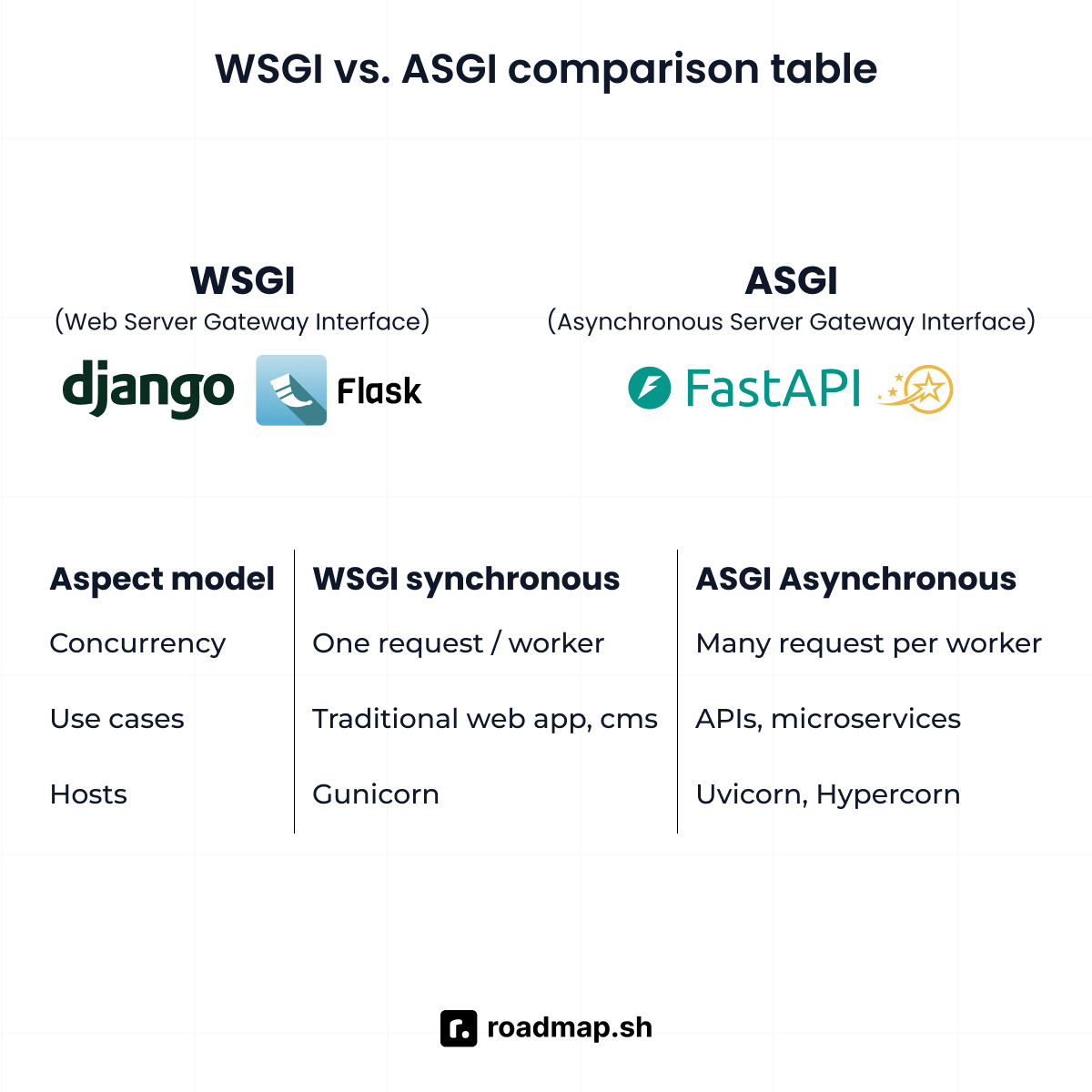
WSGI (Web Server Gateway Interface) and ASGI (Asynchronous Server Gateway Interface) are interface specifications that connect Python web applications to web servers. They standardize how servers like Gunicorn (WSGI) or Uvicorn (ASGI) communicate with frameworks.
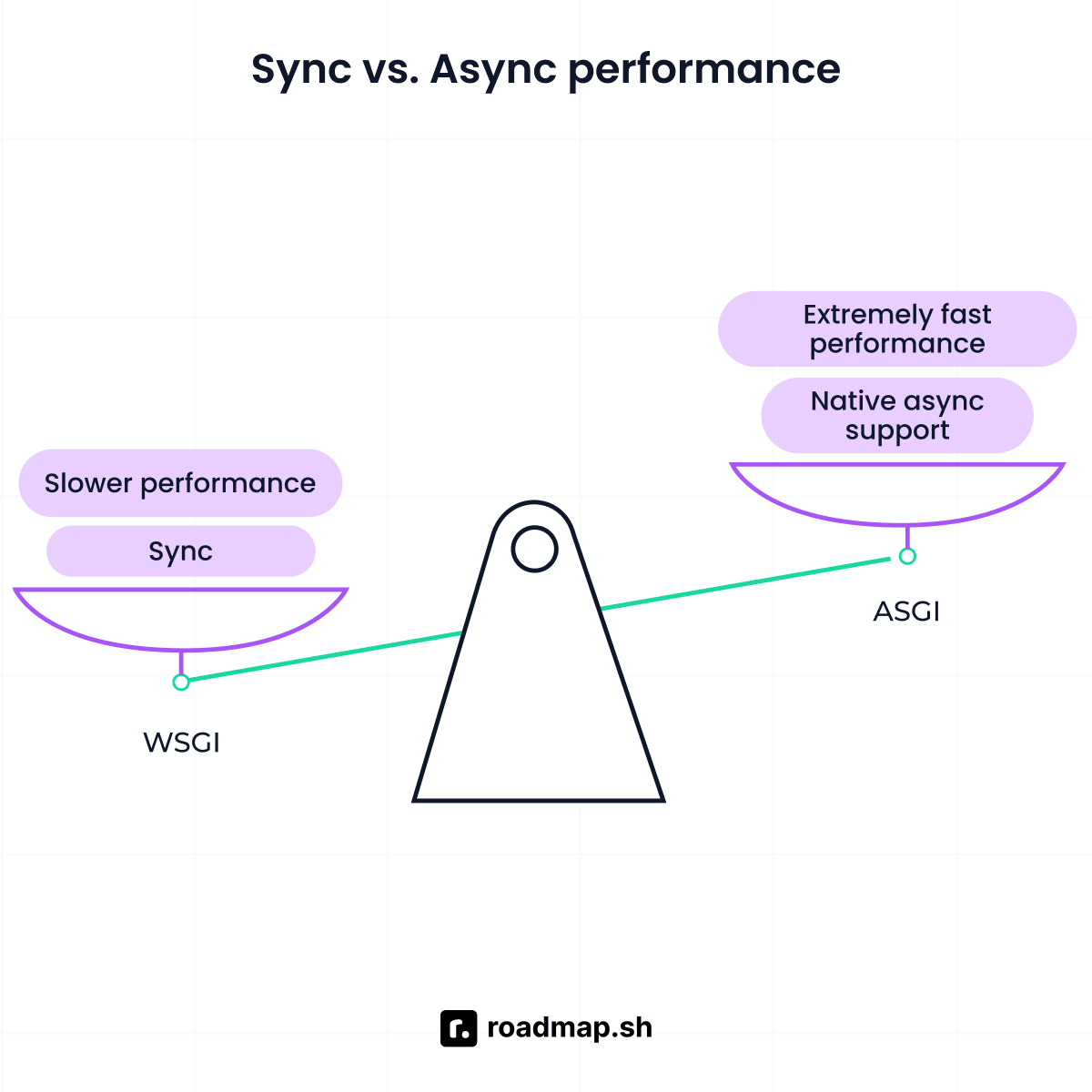
WSGI is synchronous. Each worker handles one request at a time, making it suitable for traditional web applications with predictable request cycles. Frameworks like Django and Flask are commonly built on WSGI by default.
ASGI is asynchronous. It supports concurrent request handling through an event loop, allowing multiple requests to be processed at the same time. This makes it better suited for APIs, real-time systems, and I/O-heavy workloads. Frameworks like FastAPI and Litestar are built on ASGI.
The big three Python backend frameworks
Django, Flask, and FastAPI are the most widely used Python backend frameworks today, but choosing between them usually comes down to project requirements, development style, and performance needs. Here’s how each framework fits different backend use cases.
Why Choose Django?
Django is a high-level, opinionated, full-stack framework with built-in ORM, admin panel, authentication, migrations, templating, and security features.
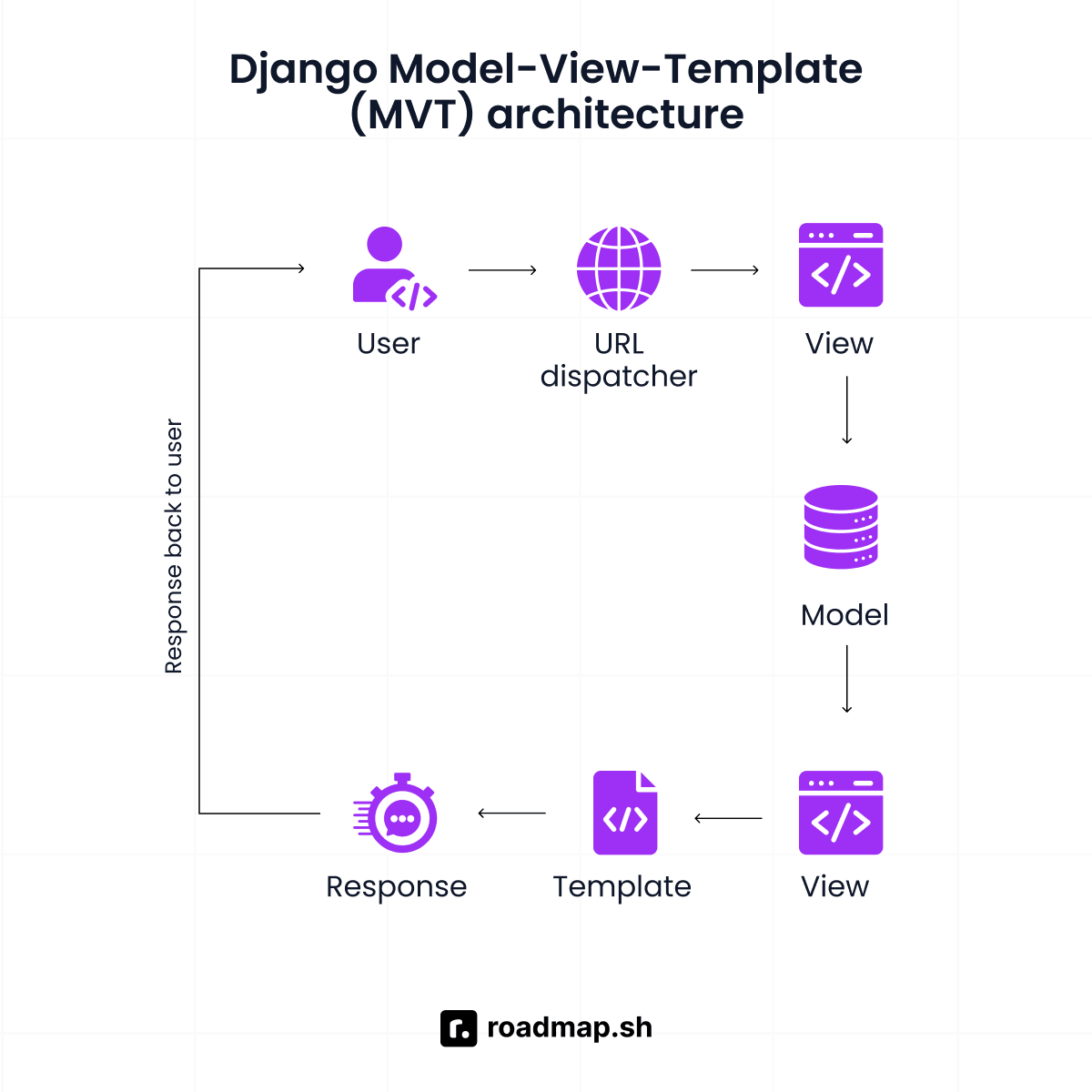
It ships with everything you need already included. User authentication, database management, security patches, all of it is already handled so you can focus on building the actual product. It follows a Model-View-Template (MVT) architecture and the Don't Repeat Yourself (DRY) principle to keep your code clean and predictable.
Django has proven itself at the highest tiers of internet traffic. It powers Instagram at three billion monthly active users, Pinterest, and Disqus, which hit a milestone of over eight billion page views a month on Django infrastructure. If your project requires data integrity and quick feature delivery, Django is a strong choice.
Django 6.0, released in December 2025, added built-in task support, native CSP (Content Security Policy) support, and further async improvements. The framework has managed to modernize without sacrificing the stability that made it popular in the first place. And if the core does not solve a problem directly, there is a good chance the Django ecosystem already has a package for it.
One pattern I have noticed teams often push back on Django's conventions, then spend the next few months recreating them.
It fits best when you are building content management systems, e-commerce platforms, admin-heavy apps, or relational data-driven applications where your team wants structure and solid documentation to lean on. Where Django is not the right call is when you are building pure APIs, need native async performance throughout, or are containerizing microservices where a lighter tool makes more sense.
If you are building APIs with Django or planning to design backend services around REST architecture, the API Design Roadmap is a good next step alongside this guide.
Here is a minimal Django setup showing a model, a view, and a URL route for a simple blog post:
Next, view queries the database and returns a JSON response:
In the code above, the default JSON encoder does not know what to do with DateTimeField values. Hence, DjangoJSONEncoder solves this for you.
Next, You just need to hook that view up to a URL route so clients can actually hit the endpoint:
In this example, the URL routes traffic to /posts/ as a working endpoint. You did not configure the database layer or write a single line of SQL. Django's built-in ORM handled the data access, which is exactly what batteries-included means. Having so much already in place can shorten the path from idea to working application. Some developers love that. Others would rather assemble only the pieces their application actually needs.
Why Choose Flask?
Flask is a lightweight Python web framework built to do as little as possible by default. It gives you routing, request handling, templating through Jinja2, and WSGI integration through Werkzeug. Everything else is added based on your project needs.
Unlike Django, Flask does not enforce a fixed application architecture. There is no built-in ORM, authentication system, admin interface, or opinionated project structure. You choose the components yourself, whether that is Flask-SQLAlchemy for database handling or Flask-Login for authentication.
Flask has outlasted newer frameworks because it never tried to be more than what it is. That same minimalism is why Netflix, Reddit, Lyft, Airbnb, and LinkedIn still run it in production. Lean does not mean limited.
Flask works best when you need minimal setup, full control over your technology stack, or fast prototyping without the overhead of a full-stack framework. It is commonly used for MVPs, ML and data science endpoints, internal APIs, and smaller backend services where reusable components matter more than built-in tools.
Flask does support async views, but it runs on WSGI by default. Without a native async server like Uvicorn behind it, it does not handle high-concurrency async workloads the way FastAPI does. If concurrent async performance is the priority, FastAPI is what you need.
If your priority is automatic validation, automatic API documentation, built-in admin tools, scalable async APIs, or a batteries-included setup, FastAPI or Django will usually fit better.
To see just how lightweight Flask really is, here is all it takes to set up a basic route and return a quick JSON response:
Flask is great until you hit its limits. Here is where FastAPI takes it up.
Why Choose FastAPI?
FastAPI is a modern, high-performance Python framework built on Starlette for ASGI support and Pydantic for automatic validation and type-safe data handling. Unlike Flask and Django, it was designed around Python type hints and native async support.
In benchmark tests on simple endpoints, FastAPI consistently outperforms Flask under concurrent workloads. That difference becomes important when building scalable APIs, microservices, and high-throughput backend systems.
FastAPI generates OpenAPI schemas automatically, including request validation, serialization, and interactive API documentation through /docs and /redoc without additional setup. It is widely regarded as having some of the best API documentation tooling in the Python ecosystem.
With over 91,900 GitHub stars and growing adoption across the Python ecosystem, FastAPI has become the leading choice for AI and ML backend workloads. Microsoft, Uber, Netflix, Hugging Face, OpenAI, and Anthropic all use it for API development and model serving.
It fits best when you are building REST APIs, microservices, or AI endpoints where performance, concurrency, and automatic validation matter. It is also a strong fit for containerized and serverless deployments. Not advisable when you need full-stack templating, built-in admin panels, or your team is not yet comfortable with async programming and Python type hints.
Here’s an example of a FastAPI app exposing a GET endpoint with automatic validation and interactive API documentation:
Now that we have walked through each framework, here is how they compare.
Django vs Flask vs FastAPI: Key Differences
What separates Django, Flask, and FastAPI is not syntax or popularity. It is the kind of engineering decisions each framework forces you to make as your application grows.
Django reduces decision fatigue by shipping with built-in tools for authentication, database management, admin interfaces, and application structure. That speeds up development for complex web applications, but it can feel heavy when all you need is a lightweight API service.
Flask gives you far more control over your application architecture and stack composition. The trade-off is that you are responsible for assembling and maintaining more parts of the stack yourself as the project grows.
FastAPI pushes developers toward asynchronous programming, type-safe APIs, and automatic validation. That improves scalability and API performance, but teams unfamiliar with async programming or Python type hints will face a steeper learning curve early on.
Choosing the wrong framework usually shows up later. A framework with too much abstraction slows down lightweight services. One with too little structure becomes difficult to maintain as complexity increases.
Beyond the Big Three: Specialized Frameworks
For most backend projects, Django, Flask, or FastAPI will handle the job well. But some workloads push beyond what those frameworks were primarily designed for: raw API performance, long-lived connections, and specialized async systems. These frameworks are worth considering if you prioritize performance or real-time communication over ecosystem size and built-in convenience:
Litestar: Litestar, formerly Starlite, is an ASGI framework built around strict typing, fast serialization, and low overhead. It uses
msgspecfor data serialization and often outperforms FastAPI in benchmark-heavy workloads. It also ships with built-in CSRF protection and session management.Tornado: When you need to push data multiple times to a lot of open connections at once, the usual request-response model of Django, Flask, and even FastAPI starts getting uncomfortable. That is the kind of workload Tornado handles. It is an asynchronous networking library and Python web framework built for long-lived connections and real-time communication.
Falcon: Falcon is a lightweight WSGI/ASGI framework designed for APIs where request handling overhead needs to stay minimal. It gives developers low-level control over the application stack and performs well in raw API benchmarks.
Which Python Backend Framework To Choose: Comparison Table
Picking a framework gets harder when all three options seem like they could work. Maybe for you Django feels productive, Flask feels flexible, FastAPI feels modern and performance-first, and suddenly the decision becomes less about features and more about what future problems you are willing to deal with.
If you are still weighing your options, here are four metrics that will make the decision clearer: what you are building, your team's experience, your performance requirements, and your long-term maintenance plan. Here is a cleaner way to think about it:
Use cases | Framework |
|---|---|
Full-stack web app with admin, auth, CMS | Django |
Learning web development fundamentals | Django or Flask |
Legacy WSGI integration | Django or Flask |
Small project, prototype, or MVP | Flask |
Pure REST API or microservice | FastAPI |
ML/AI model serving endpoint | FastAPI |
Maximum throughput, senior team | Litestar |
Real-time / WebSocket-heavy | Tornado |
Frameworks are only one piece of backend engineering. The Backend Roadmap covers what sits around them, from API security and caching to Docker and web servers.
But back to the decision in front of you. Team experience influences the framework choice more than people admit. A team already comfortable with async programming and Python type hints will adapt to FastAPI much faster, while teams earlier in their Python web development journey often move faster with Django or Flask.
Django has been around long enough that most problems you will hit already have a documented solution, a community thread about it, and a package that solves it. If you are building complex apps, that community support alone saves hours. Flask has stayed minimal by design, and its community-driven extensions grew around that without changing what it is.
FastAPI is moving fast. Async programming and AI workloads are pulling it forward, and the Python ecosystem is catching up with it.
Conclusion
No single Python framework dominates because no two backend problems are identical.
Django handles full-stack, structured applications that need auth, ORM, admin, and migrations without you wiring them together. Flask gives you a lean base and full control over what gets added. FastAPI is built for modern async APIs where performance, validation, and automatic documentation matter. When your requirements push past what those three were designed for, Litestar, Tornado, and Falcon are where you look next.
The framework itself is not the problem. Most backend issues come from forcing the wrong tool into your workload.
The Python ecosystem is still moving fast, particularly in asynchronous programming, scalable APIs, and AI infrastructure. Where the ecosystem is heading matters just as much as the framework you pick today.
If you don't want to make the amateur mistake of picking a framework based on hype, don't stop here. The Django Roadmap takes you through Django from first principles to production, along with a complete, structured roadmap for every framework covered in this guide.
