Types of NoSQL Databases: How to Choose the Right One
 Ekene Eze
As a backend developer, you already know what a relational database is and probably think of MongoDB whenever you hear the term “NoSQL database.” But MongoDB is just one example of a document database, one of the four primary types of NoSQL databases. These database types are designed for different kinds of data and query patterns, and choosing the right one is often the real challenge. Choose the wrong one, and you won't just end up with slower queries. You may find that the queries your application needs are nearly impossible to write.
NoSQL, meaning “not only SQL,” works differently from the way relational SQL databases store and retrieve data. They are built to work with flexible data models suited to a specific data structure: a simple key-value pair, a nested document, a wide column, or a network of data relationships. Some modern databases even combine multiple models in a single system, often called multi-model databases. Understanding how these database types differ helps you choose the right model for your application's data and query patterns.
In this guide, you’ll learn about the four primary types of NoSQL databases and the problems each one solves, so that you can make a well-informed choice based on your project’s specific use case.
TL;DR
Choosing the right NoSQL database type is ultimately a data engineering problem. It depends on the shape of your data and how your application needs to query it. Here’s a quick rundown before we look at each in detail.
Use a key-value database if…
Your access pattern is simple, like retrieving a value by a known key and nothing else.
You need the absolute lowest read/write latency.
Your data does not have a complex internal structure that needs to be queried.
Use a document database if…
Your data is naturally hierarchical and object-like. Examples include a product with nested attributes, a user profile with embedded preferences, or a blog post with comments.
Your schema evolves frequently.
You need to query inside documents, not just look up by a single key.
Use a wide-column database if…
You need to handle massive write volumes distributed across many nodes.
Your data is time-series, event logs, sensor data, or any pattern where you write often and read by time range.
You want high node availability and the ability to survive node failures effectively.
Use a graph database if…
Relationships between data points are as important as the data itself.
You need to traverse connections, like looking for product recommendations based on purchase patterns.
Your queries involve variable-depth traversal that would require many expensive
JOINsin SQL.
NoSQL database types: Comparison table
Let’s look at how these NoSQL database types compare in the table below:
Key-Value | Document | Wide-Column | Graph | |
|---|---|---|---|---|
Data model | Key mapped to a value | JSON/BSON documents | Rows with flexible columns | Nodes, edges, and properties |
Query model | Lookup by key only | Query by any field | Query by partition key and column ranges | Graph traversal |
Schema | Schema less | Flexible (optional validation) | Fixed families, flexible columns | Schema less |
Best for | Caching, sessions, real-time lookups | Web app backends, content, catalogs | Time-series, event logs, massive write throughput | Fraud detection, social networks, recommendations |
Horizontal scaling | Excellent | Good | Excellent (built-in distributed design) | Moderate (complex at large scale) |
ACID transactions | Limited | Multi-document (MongoDB 4.0+) | Limited | Yes (Neo4j, Neptune; varies by implementation) |
Leading examples | Redis, DynamoDB | MongoDB, Firestore, CouchDB | Cassandra, HBase, ScyllaDB | Neo4j, Amazon Neptune, JanusGraph |
What are the types of NoSQL databases?
NoSQL emerged in the late 2000s as the explosive growth of Web 2.0 pushed traditional relational databases (RDBMS) beyond their practical limits. This shift was driven by three key challenges: scalability limits, rigid schemas, and the high cost of achieving high availability. In response, new types of databases were developed with different data models and distributed architectures better suited to those demands.
Despite its name, many NoSQL databases support SQL-like query languages like Cassandra's CQL and Cosmos DB's SQL API. The defining characteristic of NoSQL databases is that they do not use the relational table as their primary data model.
This trade-off comes down to a concept known as the CAP theorem, which describes three properties of distributed systems: consistency, availability, and partition tolerance. Because network partitions are unavoidable in distributed systems, a database must choose between consistency and availability when a partition occurs. Traditional relational databases lean toward strict, ACID-style consistency, while most NoSQL databases favor availability, accepting eventual consistency, where replicas catch up over time rather than updating instantly. Understanding this trade-off is essential for choosing the right NoSQL type for your workload.
NoSQL databases are grouped into four main categories based on how they model and store data. Each category has its own strengths, trade-offs, and ideal use cases, which are covered in-depth in the following sections.
Key-value databases
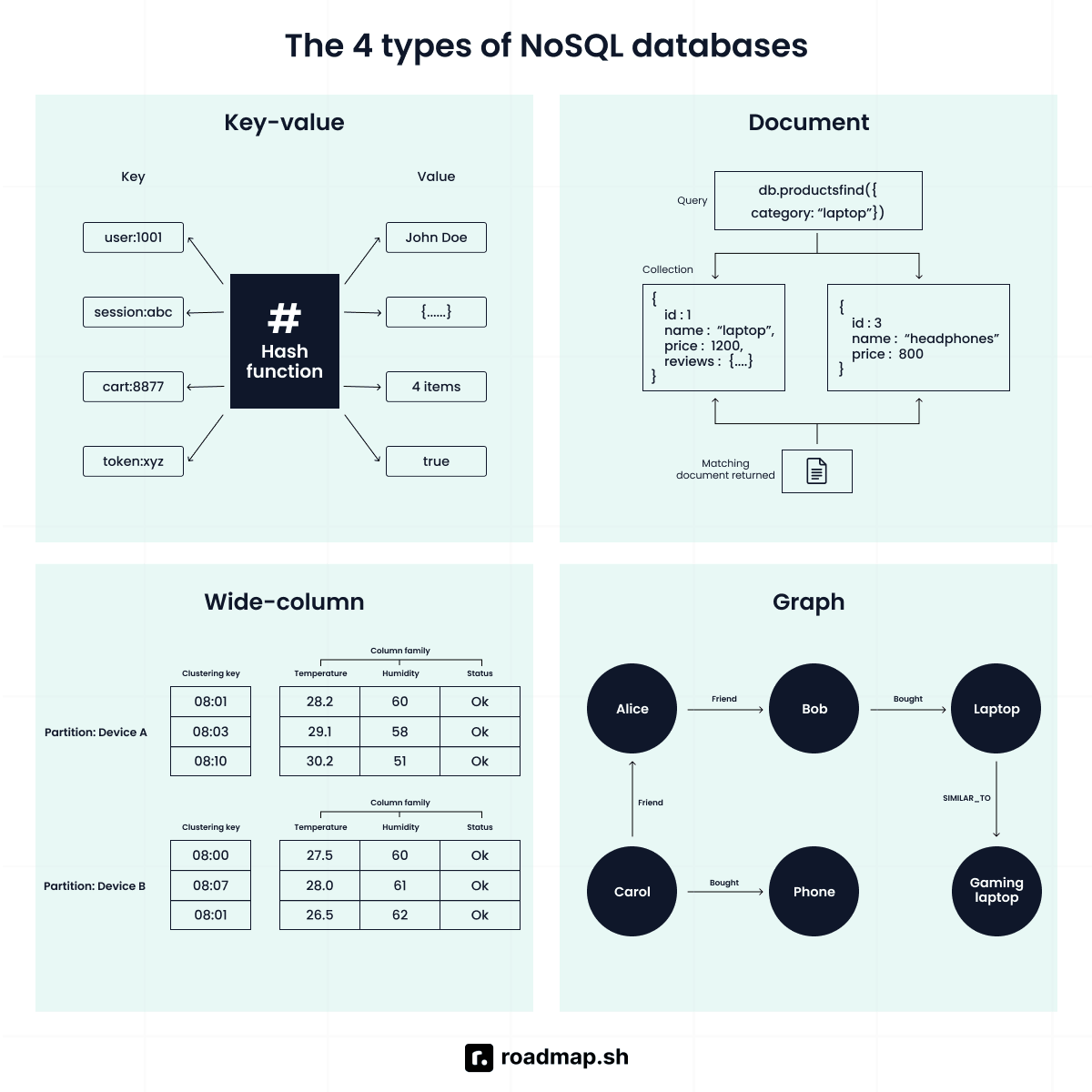
Key-value databases are the simplest NoSQL type. Every piece of data is stored as a pair: a unique key and a value. The value can be a simple string, an integer, a complex blob, or a serialized JSON object. This type of database does not know or care about the structure inside the value; instead, it only knows how to find and return the value by its key. Popular key-value databases are Redis, Amazon DynamoDB, and Memcached.
How key-value databases work
Instead of managing rows and columns, your application simply asks for a specific identifier like a user ID or session token, and the database instantly returns the corresponding payload. The database treats this value as a completely flexible blob, regardless of whether you’re storing plain text, an image binary, or a structured JSON object. It completely leaves the data validation to your application code.
For example, in Redis, you store and retrieve a user session like this:
The database doesn't parse or understand the JSON inside the value, it just outputs the raw blob stored under that key.
Under the hood, when a query is made, the database bypasses the typical disk searches and complex table joins of relational systems. It uses an internal hash table or index to point directly to the exact memory address where that key is. This algorithmic shortcut means the database can locate any piece of data instantly, maintaining quick response times whether you’re tracking ten or tens of millions of active user sessions.
Strengths
Extreme speed: Redis, for example, can handle millions of operations per second on a single node. This is largely because of O(1) key lookups.
Simplicity: They require little to no upfront data model design, making them easy to understand and work with.
Robust data structures: Redis supports lists, sets, sorted sets, hashes, streams, and pub/sub, providing more functionality beyond key-value pairs.
Automatic expiration: Also known as Time-To-Live (TTL), keys can be configured to expire automatically, making them well-suited for caching and session management.
Limitations
Limited querying: Key-value databases cannot natively query fields within stored values, so filtering by a specific field typically requires reading every value in application code.
No relationships: There is no native way to model relationships between different keys, making it difficult to represent interconnected data.
Memory constraints: In-memory key-value databases such as Redis are limited by the amount of available RAM, which can restrict the size of the dataset they can efficiently store.
In practice, when a team’s workload outgrows a relational database, trying to bolt custom caching logic onto it often adds unnecessary complexity, mixes concerns, and becomes harder to maintain over time. Introducing a dedicated key-value database to handle transient data is a much faster, cleaner, and more maintainable pattern.
Document databases
Document databases store data as self-contained JSON or BSON documents. Unlike key-value databases, a document database understands the data structure inside each document and can index and query individual data elements. Popular document databases are MongoDB, Firestore, Couchbase, and Amazon DocumentDB. They are particularly useful where structured and semi-structured data coexist within the same collection, such as content management systems, e-commerce catalogs, and user profiles.
How document databases work
Each document in the database contains all the information for a single record, including nested objects and arrays, so related data stays together. Documents in the same collection can also have different structures, making it easy to store records with varying fields without changing the database schema.
A product document, for example, might contain a nested inventory object and an array of reviews, all within a single document.
A query like db.products.find({“category”: “laptop”, “price”: {“$lt”: 1000}}) returns every laptop priced below $1000 by searching the document fields directly. Indexes can be created on both top-level and nested fields, allowing the database to find matching documents efficiently instead of scanning the entire collection.
Strengths
Documents map directly to an object in application code, so no ORM layer is required to assemble data from several tables.
Its flexible schema allows for new data elements to be added to a document without migration.
MongoDB’s sharding distributes documents across multiple nodes automatically, supporting datasets from gigabytes to petabytes.
MongoDB Query Language (MQL) supports filtering, aggregation pipelines, geospatial queries, and full-text search.
Limitations
There is no native JOIN, so cross-collection queries require multiple round-trips or denormalization.
Its flexibility can also quietly undermine data consistency as different developers write different fields to the same collection.
Multi-document transactions add performance overhead. You will need to design schemas to minimize the need for cross-document transactions.
Wide-column databases
Wide-column databases organize data into column families, where each row can hold a different set of data elements, and storage is spread across multiple servers using a distributed architecture. They are built for managing data at scale.
Popular wide-column databases are Apache Cassandra, Google Bigtable, and Apache HBase. Apache Cassandra, the most popular wide-column database, is used in production by companies including Apple, Netflix, and Instagram because of its ability to handle very large volumes of writes. It can handle such volume with no single point of failure, a workload that also benefits from real-time analytics on financial data and other time-stamped records.
How wide-column databases work
Wide-column databases organize data into rows grouped by a partition key, which determines where the data is stored across the cluster. Within each partition, rows are sorted by a clustering key, making it easy to retrieve related records in order. Unlike relational databases, rows in the same table can contain different columns, so each row only stores the data it needs.
For example, a table storing IoT sensor readings might use device_id as the partition key and timestamp as the clustering key.
A query that includes device_id can retrieve all readings for that device quickly because the database knows exactly which partition to search. New data is then appended sequentially using a log-structured merge-tree (LSM-tree) design, allowing the database to handle large data volumes without slowing down.
Strengths
Built for massive horizontal scaling. Adding more nodes increases storage capacity and throughput without relying on a single master node.
High availability through data replication across multiple nodes, allowing the database to continue serving requests even if one or more nodes fail.
Optimized for append-heavy workloads such as IoT sensor data, application logs, event streams, and time-series data.
Provides tunable consistency, allowing you to choose how many replicas must acknowledge a read or write to balance consistency, availability, and latency.
Limitations
Requires careful schema design around your application's query patterns. Changing the partition key after data has been written typically requires migrating the data.
Does not support ad-hoc queries efficiently. Queries that don't use the partition key or clustering key are often expensive.
Uses eventual consistency by default, meaning replicas can temporarily contain different versions of the same data until synchronization completes.
Graph databases
Graph databases model data as nodes and edges: a node represents an entity, and an edge represents the relationship between two nodes. Every edge has a direction and can have properties. Graph databases particularly excel at traversing these connections efficiently. Popular graph databases are Neo4j, TigerGraph, Amazon Neptune, and JanusGraph. Neo4j remains the most widely used native graph database in the fast-growing NoSQL segment.
How graph databases work
The nodes in a graph database store properties about an entity, and the connector edges store properties about the relationship between the nodes. This allows the database to move directly from one node to another instead of matching rows across multiple tables.
For example, if you’re using Neo4j’s Cypher query language for an e-commerce graph, it’ll look like this:
A query like "find the categories of products purchased by user 42" simply follows the relationships from the User node to the Product node, and then to the Category node, instead of performing multiple table joins. Since each node stores direct references to its adjacent nodes, graph databases can analyze complex relationships efficiently even as the graph grows.
Strengths
Simplifies complex relationship queries that might require 5-10
JOINs in a relational database into a single graph traversal.Traverses shared attributes, such as phone numbers, IP addresses, or devices across millions of accounts in milliseconds, making it ideal for fraud detection systems.
Effective for recommendation engines as queries are natural graph traversals.
Effective for representing complex domain knowledge as a connected graph for AI/ML applications, supply chain relationships, or enterprise data catalogs.
Limitations
Scaling to very large graphs is architecturally complex because relationships cross shard boundaries.
Graph databases are not suited for non-relational data. If your application rarely queries relationships between entities, a document or key-value database is simpler and faster.
Graph query languages like
Cypherhave a steeper learning curve thanSQL, and finding engineers with graph database experience is harder than findingSQLorMongoDBexperience.
How to choose the right NoSQL database type
The right NoSQL database type for your project is not determined by popularity or what the tutorial you found happened to use. It is determined by these three questions: what shape is your data, how does your application need to query it, and what are the scale requirements.
Start with your data shape
One of the quickest ways to narrow your database choice is to look at the shape of your data before thinking about performance, scalability, or features. Every database is optimized for storing and querying a particular type of data, so the best database is usually the one whose data model best matches your application’s data.
Here’s how to think through it:
Key-value database: Use if your data shape is a simple lookup where every value is retrieved by a unique identifier. This works best because they are optimized to fetch a value instantly using its key.
Document database: Use if your data shape is a self-contained object with nested fields, arrays, or optional attributes. In these databases, related information lives in a single document, making it easy to store
JSON-like data that evolves over time.Wide-column database: Use if your data shape consists of large volumes of records grouped by a common identifier and continuously written over time. In these databases, data is partitioned for horizontal scaling and optimized for sequential writes.
Graph database: Use if your data shape is a network of connected entities where relationships are central to your queries. These databases follow relationships directly instead of reconstructing them through joins.
Consider your query patterns
The way your application reads data is often more important than the way it stores data, especially for NoSQL databases. Unlike relational databases, where you start by modeling the domain and let SQL joins reconstruct the data you need later, NoSQL schemas are designed around the application’s read patterns.
Here’s how to approach the decision:
Key-value database: Consider if your query pattern involves retrieving data by a single known identifier. If every request looks like “Get user session abc123" or “retrieve cart cart_456,” a key-value database is all you need.
Document database: Opt for this if your query pattern involves filtering, sorting, or searching by fields inside records. With this database type, you can query fields like
category,price, orcreated_atand use indexes to make those searches fast.Wide-column database: Choose if your query patterns retrieve data using a predictable partition key. Queries are most efficient when the partition key is provided, such as retrieving all sensor readings for a device or all transactions for a customer.
Graph database: Go for this if your query pattern explores relationships between connected records. Queries like "friends of friends who purchased Product X" or "employees who report to managers in another department" involve traversing relationships of unknown depth.
Scale and consistency requirements
Choosing a database that meets your current needs while leaving room for growth is better than designing for workloads that you’ll likely never have. Also, consider data consistency in your application. Some databases prioritize availability and write throughput over ensuring instant writes.
Here's a practical way to think about it:
Key-value or Document database: Consider if your priority is scaling beyond a single server. They are the best fit for scaling horizontally and comfortably handling the workloads of most modern applications.
Wide-column database: Consider if your priority is handling massive write volumes and ensuring high write throughput and availability even under heavy load. It is the best fit because it is built for workloads that exceed what a single machine can realistically handle, such as event logging,
IoTtelemetry, and clickstream analytics.Graph database: Consider if your priority is scaling highly connected data. It is particularly efficient at traversing relationships using direct connections between nodes, allowing it to handle billions of nodes and edges on a single machine while maintaining fast relationship queries.
Wrapping up
There isn’t a single “best” NoSQL database or type, only the one that best matches your application’s data shape, query patterns, and scalability requirements. Key-value databases excel at ultra-fast lookups, document databases handle flexible JSON-like data with ease, wide-column databases are built for massive distributed workloads, and graph databases shine when relationships between data are at the heart of your application.
The NoSQL ecosystem continues to evolve, with multi-model databases such as ArangoDB and Azure Cosmos DB gaining adoption. By supporting multiple data models within a single database, they reduce the operational overhead of managing separate databases for different workloads. At the same time, the continued growth of cloud-native applications, AI and machine learning workloads, and real-time systems is expected to drive even broader adoption of NoSQL databases.
Whichever database type you choose, our backend and data engineer roadmaps are a great place to get started. Also, if you already know the database for your use case, our dedicated MongoDB and Redis roadmaps may be of help. If you haven’t already, create a roadmap.sh account to track your progress, save your learning paths, and access personalized roadmaps as you continue in your tech journey. The AI Tutor is also available if you want to explore any database concept further or ask follow-up questions.
- Backend Developer Job Description in 2026
- Top 7 Backend Frameworks to Use in 2026: Pro Advice
- Top 10+ Backend Technologies to Use in 2026: Expert Advice
- 20 Backend Project Ideas to take you from Beginner to Pro
- 25 Essential Backend Development Tools for 2026
- 8 In-Demand Backend Developer Skills to Master
- The 5 Best Backend Development Languages to Master (2026)
