MongoDB vs. PostgreSQL: Key differences and when to use each
 William Imoh
You’re starting a new project, or you’ve inherited someone else’s, and now you need to decide what will power your application’s data layer: MongoDB or PostgreSQL. If you’re looking to make an informed decision rather than one that could cost you later, you need to start by understanding the strengths, tradeoffs, and ideal use cases of each database system.
Both databases have a strong case to make. MongoDB combines a document-based data model, flexible schema design, and built-in support for horizontal scaling. PostgreSQL combines a mature relational data model, powerful querying capabilities, and the reliability that has made it a popular choice for decades. Neither is inherently better than the other, which is why the decision isn’t straightforward, and why it's important to get it right from the beginning.
In this guide, you’ll learn how MongoDB and PostgreSQL differ and where each one fits best, so you can confidently choose the right database for your project.
TL;DR
Go for MongoDB if...
Your data is document-oriented with unpredictable or frequently changing schemas.
You're building content management systems, IoT platforms, real-time event systems, or mobile apps with offline sync.
Horizontal sharding from day one is a concrete requirement.
Your team is primarily working in JavaScript or Node.js and values native JSON document workflows.
You're building AI/ML applications that need Atlas Vector Search with direct text-to-vector transformation at write time.
Speed of iteration matters more than query performance during early-stage development.
Go for PostgreSQL if...
Your data is relational with entities, foreign keys, and join-heavy queries.
ACID compliance across multiple tables is non-negotiable.
You want to combine structured and semi-structured data in one database using JSONB columns.
You're building analytical workloads: window functions, aggregations, complex reporting.
You want access to the broader PostgreSQL extension ecosystem: PostGIS (geospatial), pgvector (AI/vector search), TimescaleDB (time-series), and Citus (distributed).
You care about career transferability.
You want a permissive open-source license.
MongoDB vs. PostgreSQL: Comparison table
Let's look at how these databases compare in the table below:
Feature | MongoDB | PostgreSQL |
|---|---|---|
Type | Document database (NoSQL) | Relational database (SQL) |
Data model | JSON-like documents (BSON) | Tables with rows and columns |
Schema | Flexible (optional validation) | Structured (predefined schema) |
Query language | MQL (MongoDB Query Language) | SQL (Structured Query Language) |
ACID transactions | Yes (multi-document, since v4.0) | Yes (native, across all tables) |
JSON support | Native (BSON documents) | JSONB (indexed, queryable) |
Horizontal scaling | Native sharding built in | Available via Citus extension or partitioning |
Vertical scaling | Yes | Yes (primary scaling strategy) |
Vector search | Atlas Vector Search (managed) | pgvector extension |
License | SSPL, Commercial License | PostgreSQL License (open source) |
Managed cloud | MongoDB Atlas | Supabase, Neon, RDS, Aurora |
Developer adoption | 24% | 55.6% |
Best for | Document-oriented, flexible schema, write-heavy | Relational, complex queries, data integrity |
What is a relational database? Understanding PostgreSQL
PostgreSQL is an open-source object-relational database management system with over 35 years of active development. According to the Stack Overflow Developer Survey of 2025, it's the most admired and desired database and has been for three consecutive years (2023–2025). The survey also found that 55.6% of developers use PostgreSQL, making it the most widely used database in the industry.
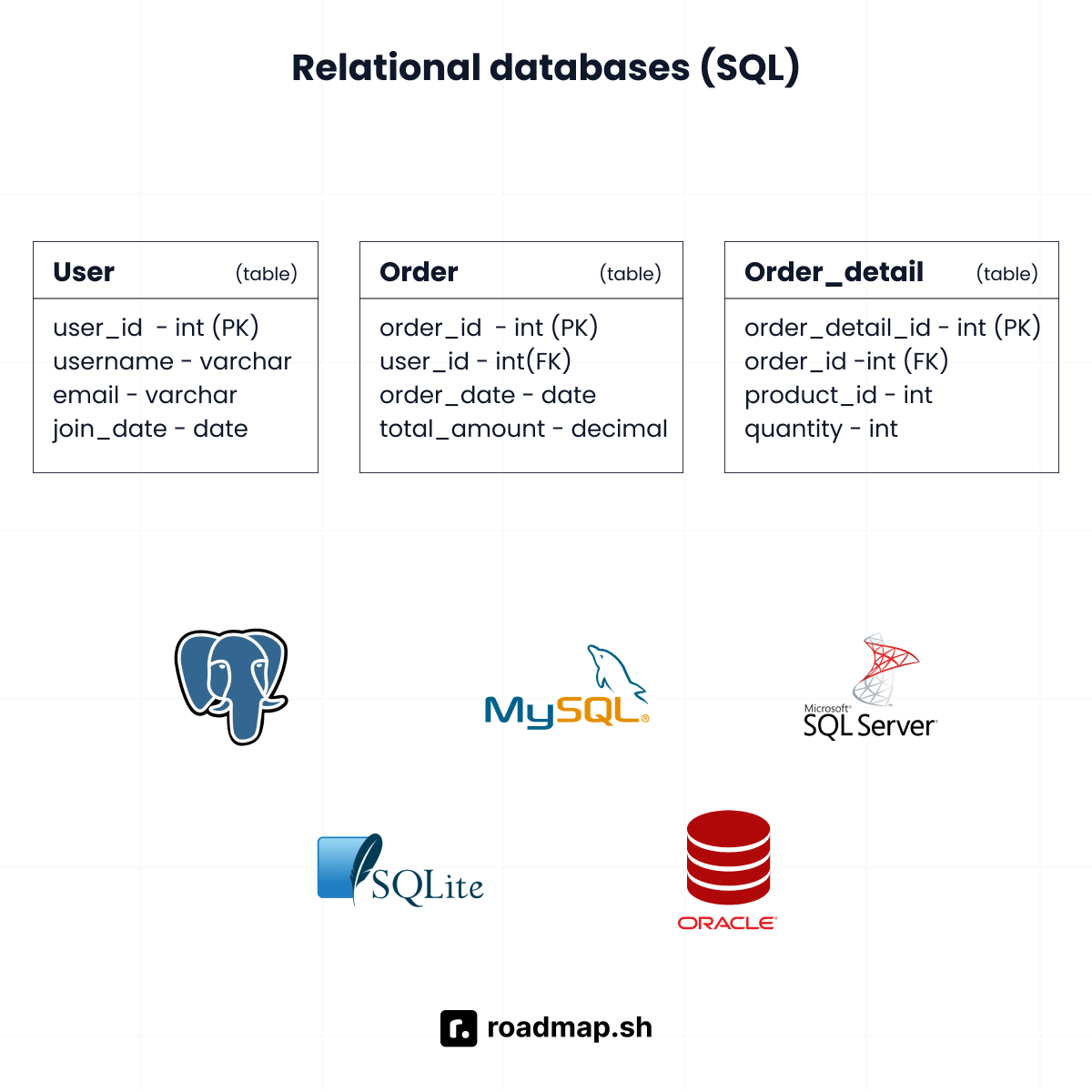
The following are key capabilities and characteristics that have made PostgreSQL a popular choice over the years.
Structured data and SQL
PostgreSQL stores data in structured tables made up of rows and predefined columns. Each column has a specific data type, ensuring that data is stored consistently. Relationships between tables are defined using primary and foreign keys, allowing the database to enforce connections between related records rather than relying on application logic alone.
Data is queried using SQL, the standard language for working with relational databases. In my experience, SQL skills can be easily transferred to other traditional relational databases such as MySQL, SQLite, SQL Server, and many analytical warehouses.
Modern PostgreSQL versions are narrowing the distinction between structured and semi-structured data. PostgreSQL 17 introduced the JSON_TABLE() function, which allows semi-structured JSON to be transformed into relational rows with full SQL query capabilities. This makes it easier to work with JSON data without leaving the relational model or introducing additional tools.
ACID compliance and data integrity
PostgreSQL provides full ACID guarantees across any number of tables and operations. ACID in databases refers to a set of four key properties, Atomicity, Consistency, Isolation, and Durability, that guarantee database operations are processed reliably and ensuring data integrity. This is the foundation of financial systems, e-commerce platforms, and anything where strict data consistency is non-negotiable. PostgreSQL also has row-level locking and multi-version concurrency control built in, making it suitable for reliable transaction processing.
Let's look at a money transfer between two bank accounts. A transfer requires both accounts to be updated: one account is debited, and the other is credited. By wrapping both operations in a transaction, PostgreSQL guarantees that either both updates succeed or neither does.
This single transaction demonstrates all four ACID properties: Atomicity ensures the debit and credit are treated as one unit of work, so PostgreSQL can roll back the entire transaction if either updates fails. Consistency ensures the database honors the declared constraints before and after the transaction. Isolation prevents concurrent transactions from interfering with each other while the transfer is in progress. Durability guarantees that once committed, the updated balances persist even if the database crashes.
JSONB: The hybrid option
JSONB lets PostgreSQL combine the structure of relational tables with the flexibility of document databases. You can keep your core data in structured columns while storing less predictable or optional data in a JSON document. PostgreSQL can efficiently index and query JSONB, allowing you to search within JSON documents while benefiting from the reliability and relational features of a traditional SQL database.
A practical example is an e-commerce catalog. Every product might have a name, price, and category, but the attributes vary. A laptop may have RAM and storage specifications, while a shirt has size and color. Instead of creating dozens of mostly empty columns, you can store those variable attributes in a JSONB field.
JSONB columns aren't automatically indexed. Without an explicit GIN index, queries against a JSONB field force a full table scan — which is fine on a small table, but slow once your catalog grows. I advise using this approach when most of your schema is stable, but a small portion of the data varies between records. It is one of the reasons PostgreSQL is often considered for projects that need some of the flexibility of a document database without giving up the strengths of a relational database.
Extensions and ecosystem
One of PostgreSQL’s biggest strengths is its extension ecosystem. Rather than introducing a separate database whenever requirements change, you and your team can extend PostgreSQL to handle new workloads.
PostGIS adds support for geospatial data and location-based queries, pgvector enables vector storage and similarity search for AI applications, and TimescaleDB is designed for time-series data such as metrics, logs, and real-time analytics dashboards. Extensions like Citus can even help scale PostgreSQL across multiple nodes when a single server is no longer sufficient.
This flexibility lets teams continue using PostgreSQL as their needs change, without having to adopt and manage an entirely separate database solution. With the growth of managed and serverless PostgreSQL platforms such as Neon, Supabase, and Aurora Serverless v2, many of the operational advantages that once led teams to shift to alternative databases have become less significant.
What is a document database? Understanding MongoDB
MongoDB is a document-oriented NoSQL database that stores data as flexible, JSON-like documents. These documents are represented in BSON (Binary JSON), a format that extends JSON with additional data types and improves storage and retrieval efficiency.
Unlike relational databases, which organize data into rows and tables, MongoDB stores related information together in a single document. This makes it easier to work with evolving data structures and applications that don’t require a fixed schema.
MongoDB's document-based approach to data storage is one reason why MongoDB databases feel natural to developers coming from JSON-heavy web stacks.
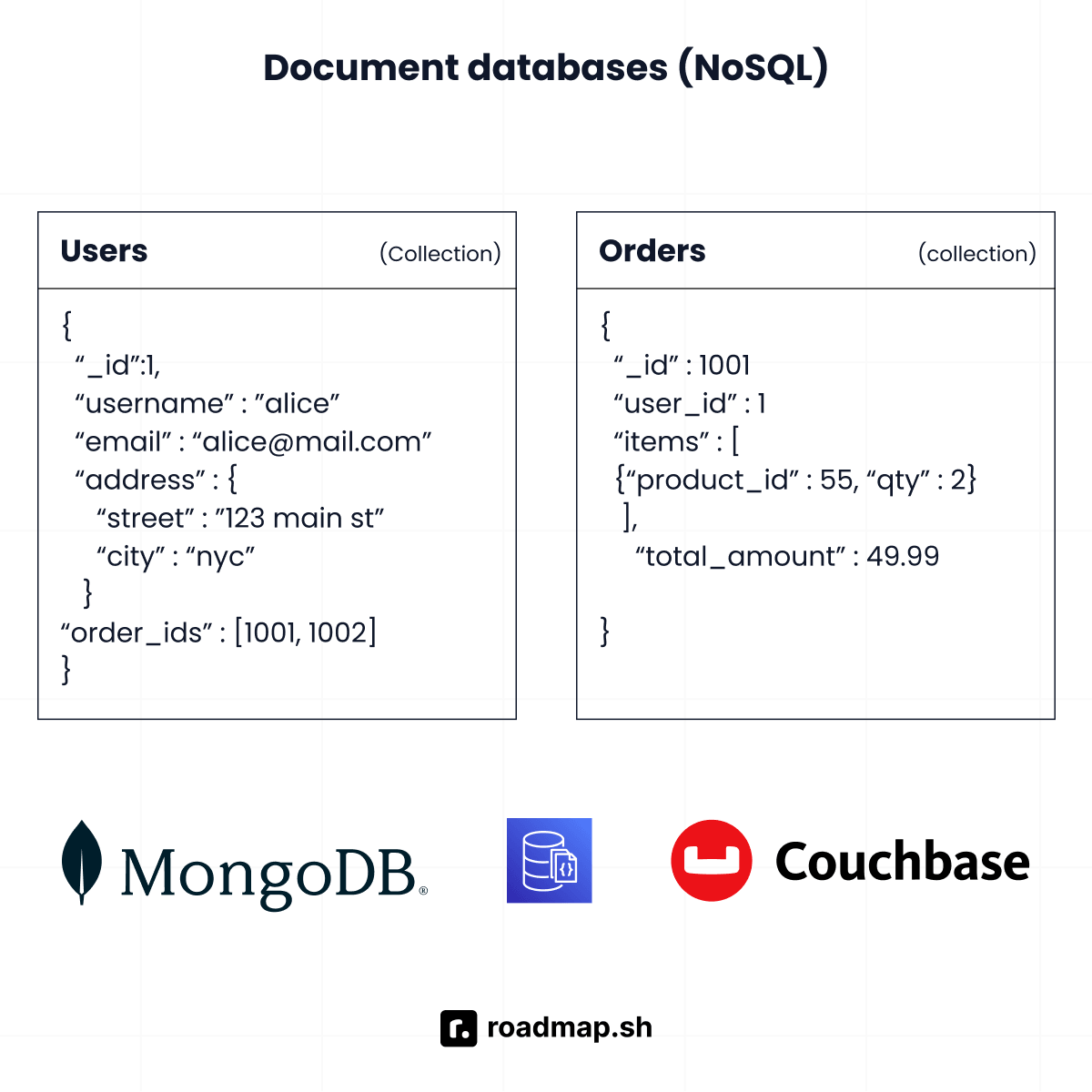
The following are key capabilities and characteristics that make MongoDB a viable option for modern applications.
Document data model and flexible schema
MongoDB stores data as JSON-like documents. It does not require a fixed schema, so documents within the same collection can have different fields or structures depending on the application's needs.
Instead of splitting data across multiple tables and joining them at query time, MongoDB often uses a denormalized structure in which related data is stored together. In practice, this means MongoDB embeds related data directly inside the parent document. This makes it efficient for access patterns that frequently read or manipulate a complete object, such as user profiles, products, or orders.
For example, a product document will typically include the product name, category, attributes, reviews, etc., directly within it, so reading the product returns everything related to it in one read.
However, MongoDB is not entirely schemaless in practice. It supports schema validation with JSON Schema, allowing you to enforce rules such as required fields, allowed data types, and value constraints.
This is a separate step from the insert example — you'd normally set up a validation when creating the collection before inserting documents into it. With JSON Schema, you can choose flexibility where needed, while still adding structure when your application requires it.
Horizontal scaling and sharding
MongoDB’s built-in sharding capabilities are one way to enable horizontal scaling by distributing data across multiple servers. This helps applications handle growing datasets and increasing write workloads without relying on third-party extensions.
MongoDB also supports replica sets, which maintain copies of data across multiple nodes. If the primary node becomes unavailable, another node can automatically take over, helping your application remain available. This architecture makes MongoDB databases a popular choice for applications that expect large-scale growth or need to distribute data across multiple servers from the beginning.
One important thing to keep in mind is that sharding introduces additional operational complexity regardless of the database used. I have seen many applications run successfully on a single database for years with little to no issues. So, if you want to use distributed sharding, you should evaluate whether it is a current requirement or a future possibility rather than just a “nice-to-have” feature.
Performance for document-oriented workloads
MongoDB is optimized for workloads where applications frequently read, write, or update complete documents. When a query can retrieve most of the required data from a single document, requests can be served more efficiently without the overhead of combining data from multiple sources at query time.
This approach can be particularly useful for high-traffic applications that handle large volumes of user-generated content, product data, session information, or application events. These types of workloads are common in social media platforms and large consumer apps. As data volume grows, MongoDB's sharding architecture makes it easier to distribute these workloads across multiple servers and increase throughput.
MongoDB Atlas and the managed cloud ecosystem
MongoDB Atlas is MongoDB’s fully managed cloud service. It handles tasks such as provisioning, scaling, backups, monitoring, and multi-region deployments, reducing the operational work required to run MongoDB in production. In recent times, Atlas has expanded beyond database hosting. It now includes features for AI applications, such as vector search, enabling teams to build and deploy AI-powered experiences without adding infrastructure.
For analytics and reporting, Atlas provides a SQL interface that enables BI tools such as Tableau and Power BI to query MongoDB data. This makes it easier for analysts and business teams to work with MongoDB without having to learn its query language.
Note: The SQL interface of MongoDB Atlas is for querying and analysis only, not for writing data.
MongoDB vs. PostgreSQL: Key differences
Now that we've covered the fundamentals of both databases, let's compare them side by side across the areas that matter most when choosing one for your next project.
Data model: Documents vs. tables
MongoDB stores nested documents with related data embedded together for fast reads. PostgreSQL stores data in tables with data relationships enforced through foreign keys, normalizing data across multiple tables. Since the data model is the pivotal aspect of your data decision, I’d say you should let your data’s natural shape guide your decision.
A product catalog with variable attributes or a user profile with deeply nested preferences fits a MongoDB model more naturally. An order-based system with a chain of relationships in which orders reference customers, and customers reference products, is what PostgreSQL is best suited for. For MongoDB to achieve the integrity that PostgreSQL naturally enforces, it must be explicitly configured, especially once complex data relationships start to emerge between collections.
Query language: MQL vs. SQL
PostgreSQL uses SQL, the most popular and portable query language for querying and managing relational data. MongoDB uses MQL, a document-oriented query language designed for working with BSON documents. PostgreSQL’s query model is built on industry standard, while MongoDB is platform-specific.
For small teams, this distinction may not matter. For larger organizations, however, it can influence onboarding, analytical workflows, and the ease with which data moves between different systems. Career-wise, SQL is more in-demand, and PostgreSQL developers outnumber MongoDB developers by more than 2:1, according to Stack Overflow 2025 survey.
Scaling strategy: Vertical vs. horizontal scalability
PostgreSQL is typically designed around vertical scaling, where applications grow by adding more resources (CPU, RAM, storage) to a single database server before moving to distributed architectures. MongoDB was built with horizontal scaling as a core architectural principle, making it easier to spread data and workload across multiple servers as demand increases.
In practice, the difference often lies in when complexity surfaces. PostgreSQL allows applications to scale significantly before teams need to consider distributed systems. MongoDB with horizontal scalability can be a better fit for applications expected to grow rapidly or operate at a large scale from the outset.
Transactions: ACID across documents vs. tables
Both PostgreSQL and MongoDB support ACID transactions but originated from different design philosophies. PostgreSQL is designed around a relational model, where relational data entities are often stored in separate tables and updated together through transactions. MongoDB is designed around a document model, where related data are kept together, reducing the need for transactions that span multiple records.
In my experience, when multi-document database transactions become a frequent requirement, it can signal that the data model is becoming more relational. As your application(s) develop more complex relationships between records, strict transactional consistency across those relationships becomes more important than the convenience of keeping everything in individual documents.
JSON and document handling: Convergence in 2026
One of the biggest changes in recent years is how much PostgreSQL and MongoDB have converged. PostgreSQL’s JSON capabilities have matured to the point where many teams can work with document-style data without introducing a separate document database. At the same time, MongoDB has added features that make it easier to enforce structure and integrate with SQL-based workflows when needed.
As a result, teams that prefer PostgreSQL can comfortably support many document-oriented use cases, while teams that choose MongoDB for flexibility can still apply validation and governance where required. The deciding factors in choosing a database in 2026 are data modeling preferences, scaling strategy, team expertise, and operational requirements.
Licensing: Open source vs. SSPL
PostgreSQL uses the PostgreSQL License, a permissive open-source license similar to MIT and BSD. It places very few restrictions on how the software can be used, modified, or distributed, including for commercial products and managed services.
MongoDB Community Server uses the Server Side Public License (SSPL). MongoDB introduced this license to prevent cloud providers from offering competing managed MongoDB services without open-sourcing the platform used to provide those services. This makes the SSPL more restrictive than traditional open-source licenses.
For most application developers, this distinction is irrelevant because it does not affect how they build or deploy applications. However, for teams building database tooling or managed services, SSPL introduces legal and compliance considerations.
Which database should you learn?
The right database system depends on your data shape, your query patterns, your scale requirements, and, if you’re making a career decision, your hiring market. Here’s how to think through each.
Situation | Recommended |
|---|---|
Relational data with joins and foreign keys | PostgreSQL |
Document-oriented data, variable schema | MongoDB |
Financial, healthcare, or compliance-critical app | PostgreSQL |
Content management system or product catalog | MongoDB |
IoT platform with high-volume writes | MongoDB |
Analytics, reporting, complex aggregations | PostgreSQL |
AI/ML app with vector search | PostgreSQL (pgvector) or MongoDB (Atlas Vector Search) |
Rapidly changing schema during early-stage development | MongoDB |
Needs both relational and semi-structured data | PostgreSQL (JSONB) |
Team primarily working in Node.js / JavaScript | MongoDB (native JSON workflow) |
Career-first choice / learning SQL fundamentals | PostgreSQL |
Global distributed writes at scale | MongoDB (native sharding) |
Use cases where MongoDB has a clear advantage
Document-oriented applications with highly variable or evolving data structures
Large-scale applications that require built-in horizontal scaling and sharding
Workloads where most operations involve complete documents rather than relationships between datasets
Use cases where PostgreSQL has a clear advantage
Applications that require strong transactional consistency across multiple related tables
Analytical, reporting, and business intelligence workloads that depend on complex
SQLqueriesApplications that need to combine structured relational data with semi-structured
JSONdata in the same databaseWorkloads that can benefit from PostgreSQL’s extension ecosystem, including geospatial, vector search, and time-series capabilities
Career and learning considerations
PostgreSQL is more widely adopted than MongoDB, as recent surveys show.
SQLskills are highly transferable across PostgreSQL, MySQL, MariaDB, SQLite, BigQuery, and many other data platforms.MQLis largely specific to MongoDB.
Wrapping up
The right database is the one whose strengths align with your application’s data model, query patterns, and your team's growth trajectory. PostgreSQL is the popular go-to database for relational and analytical data workloads, while MongoDB remains the stronger choice for document-oriented data architectures. Ultimately, the right decision is the one that matches your application's data and long-term growth plan.
Whichever path you choose, we have a MongoDB roadmap for the document database route and a PostgreSQL roadmap for the relational database route. Both offer a structured learning path to help you build a solid database foundation for your backend development journey.
If you haven't already, create a roadmap.sh account to track your progress, save your learning paths, and access personalized roadmaps as you advance through your tech journey. The AI Tutor is always available if you want to expand on any concept or ask follow-up questions.
