Java vs Kotlin Comparison: Which Language Should You Choose?
 Ekene Eze
Choosing between Java and Kotlin isn’t about finding the “better” language. It’s about picking the one that fits your specific project needs. Both run on the Java Virtual Machine (JVM) and share a rich ecosystem, but they take different approaches to solving programming problems.
Java has been the go-to language for decades, powering everything from enterprise systems like banking and fintech applications to Android apps. However, Kotlin’s modern and concise syntax, faster development workflow, and growing ecosystem are challenging that long-standing dominance, which makes it a go-to language for modern application development.
So, which one should you choose in 2026? If you’re trying to decide between Java and Kotlin for your next project, you’re in the right place. In this guide, I’ll break down what each language offers, how they compare, and which one is a better fit for your projects in 2026.
TL;DR: Java vs. Kotlin
Go for Java if…
You’re working on large-scale enterprise systems that require maximum stability and long-term support, such as banking or supply chain platforms.
You’re maintaining a complex legacy codebase or integrating with existing Java infrastructure.
You want access to a massive developer ecosystem for hiring and scaling your team.
Your team relies on a wide range of Java libraries, frameworks, and third-party tools.
You need proven runtime performance and JVM long-term support (LTS).
Go for Kotlin if…
You’re building modern Android applications where concise code and clean syntax improve productivity.
You’re starting greenfield projects and want faster iteration with modern language features.
You’re developing backend services with JVM-based frameworks like Ktor or Spring Boot and prefer cleaner, less boilerplate-heavy, and more expressive code.
You’re creating a cross-platform app and want to share code across mobile, web, and desktop while keeping development simple and fun.
Before looking at both languages in detail and how they fit into your workflow, let’s first see how their features compare to each other.
Java vs. Kotlin: Comparison table
The table below summarizes the key features of Kotlin and Java:
Features | Java | Kotlin |
Syntax and conciseness | Verbose; requires more boilerplate with explicitly define types for classes, getters/setters | Concise; data classes and extension functions with type inference support that cut code up to 40% |
Null safety | Manual checks needed; prone to null pointer exceptions | Built-in; smart casts and nullable types prevent runtime crashes |
Performance | Excellent on JVM; mature optimizations for enterprise loads | Matches Java on JVM; slight edge in native compilation for mobile |
Roadmap highlights | Java 21 as 2026 standard; long LTS support to 2030+ for stability | Multiplatform focus; Ktor enhancements like WebRTC by 2026 |
Learning curve | Steeper for beginners due to verbosity; familiar to most devs | Easier entry with modern features; Java knowledge transfers seamlessly |
Interoperability | Full JVM interoperability | 100% with Java; call Java code directly, no wrappers needed |
Public static / public static void main | Uses public static for class methods and public static void main as the entry point. | No public static; entry point is a top-level fun main() function. |
Ecosystem | Extensive libraries (Spring, Hibernate); dominate enterprise tools | Leverages Java libs fully; adds Ktor, Compose for modern stacks |
Community and adoption | Massive community (30+ years) and considered as the enterprise king | Rising fast (Android official lang); 10x growth in JVM alternatives |
Coroutines | Requires external libraries | Built-in coroutines for async programming |
Checked exceptions | Handles exceptions using try-catch or declare with throws; compile-time enforcement | No checked exceptions; cleaner code but risk of missing error handling |
Default values | Requires overloaded constructors for default parameters | Supports default values in primary constructors, simplifying object initialization |
Preview feature (string templates) | String templates are a preview feature in recent Java releases, allowing embedded expressions in string literals. | Native support for string templates |
Higher order functions | Limited support with modern Java with the use of Lambdas | Built-in support for higher-order functions, lambdas, and functional programming. |
Operator overloading | Not supported, but uses method names for operators | Supports native operator overloading in Kotlin and a custom implementation of operators |
Platform independence | Java codes are platform independent and can run on any device with a JVM | Kotlin is also platform-independent and supports multiple platforms |
Primitive types | Primitive types Java: 8 built-in types (int, byte, short, double, float, boolean, char, long); not objects, stored directly in memory. | Kotlin treats all types as objects, even those corresponding to Java's primitive types. |
Maintained by | Oracle | JetBrains |
Now that we’ve seen how Java and Kotlin stack up side by side, it’s easier to spot where each one shines. But choosing a language isn’t just about comparing features; it’s about finding the right fit for your project and workflow. So, let’s break down why you might want to go with Java or Kotlin, depending on what you’re building.
Why choose Java?
Java, an object-oriented programming language, has been around since the mid-1990s and still powers some of the world’s most critical enterprise systems. Its stability and reliability make it a safe choice for long-term projects like banking systems, trading platforms, and cloud infrastructure. The promise of “write once, run anywhere” still holds true across billions of devices, making Java platform independent and enabling code to run on any device with a Java Virtual Machine (JVM).
What makes Java a strong choice in 2026 is its steady modernization. Despite being the OG of programming languages, it continues to evolve with features like pattern matching, virtual threads, and optimized garbage collection. These updates address many JVM pain points that once pushed developers toward alternatives.
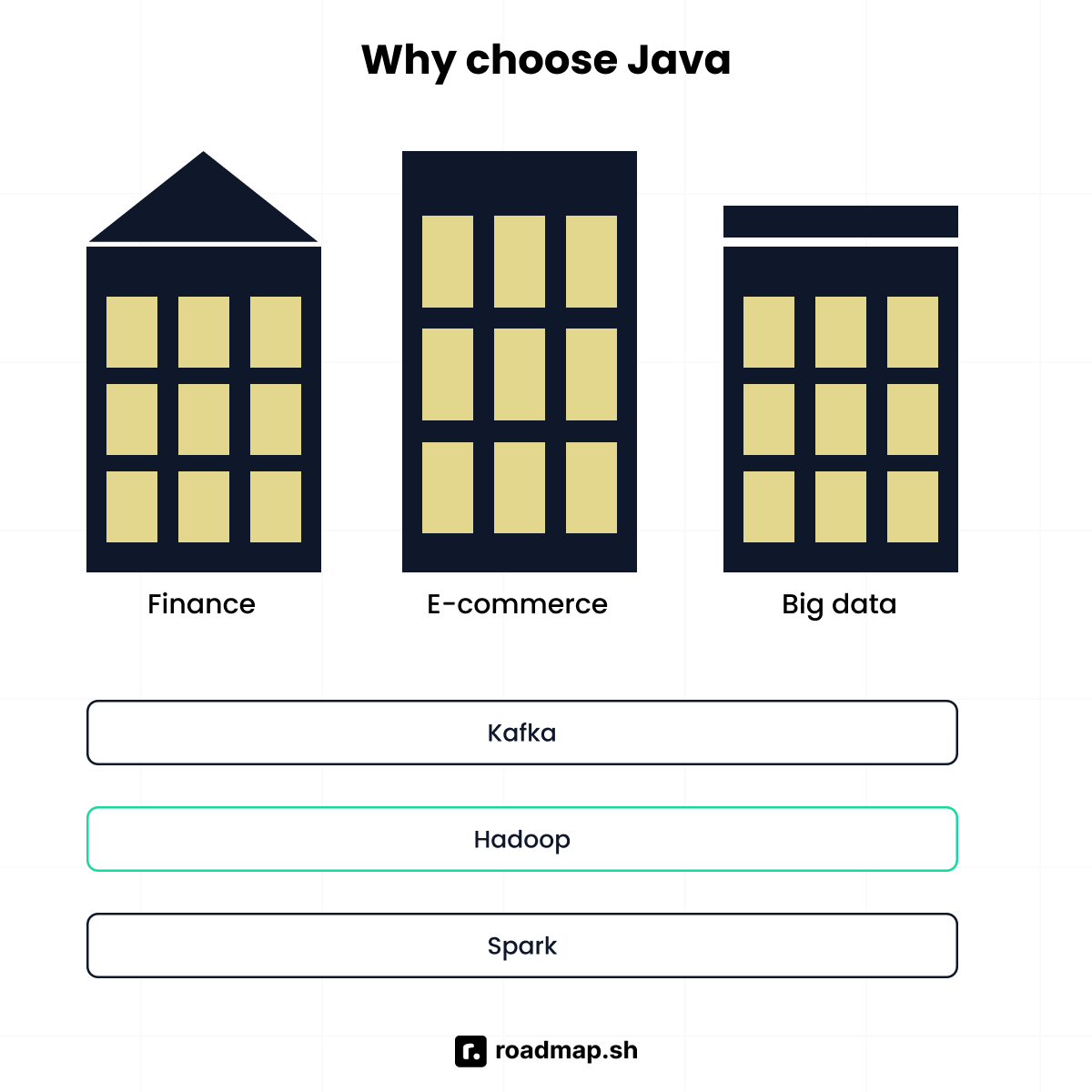
Here’s why adding Java to your tech stack in 2026 still makes a lot of sense:
Enterprise stability
If there’s one thing you’ll appreciate about Java, it’s the stability it brings. Its LTS model provides predictable release cycles, so your projects don’t break overnight because of sudden changes. Java keeps changing while maintaining backward compatibility you can count on. When you build with Java, you’re building for the long game, not just the next product sprint.
Huge ecosystem
Many newer languages with modern syntax struggle to attract enough developers or build strong communities. That’s not the case for Java. With over nine million developers worldwide, ranging from juniors to senior architects, finding Java talent for both new and legacy projects is straightforward.
Training programs, bootcamps, and certifications are available everywhere, making it easy to hire or upskill developers in any tech hub around the world.
Strong backward compatibility
Java’s commitment to backward compatibility is one of its biggest strengths. You can take code written a decade ago, and chances are it’ll still run on a modern JVM. This saves both time and money and makes upgrading to newer versions far less painful than with most languages.
Excellent performance and tooling
The JVM’s Just-In-Time (JIT) compiler and advanced garbage collection have been optimized for decades and continue to improve. Modern distributions like Oracle JDK and OpenJDK deliver near-native performance right out of the box.
Java also offers a mature and comprehensive tooling ecosystem, including:
Eclipse, IntelliJ IDEA, and VS Code with great Java support for writing Java code
Maven and Gradle for building Java projects
TestNG and JUnit for testing Java code
Profiling tools like VisualVM and YourKit
Beyond the points above, Java also has many practical use cases across different industries. For example:
JPMorgan Chase runs its critical trading systems on Java, which makes it ideal for building financial services applications.
SAP, one of the leading enterprise resource planning systems, uses Java extensively for its backend services.
Apache Hadoop, Apache Kafka, and Apache Spark are all written in Java, and they’re among the most reliable tools for processing big data.
eBay’s backend runs on Java, handling millions of transactions every day, which shows how reliable Java is for building e-commerce platforms.
If your use cases revolve around financial services, enterprise backends, processing large amounts of data, or scaling e-commerce, choose Java because it shines in these domains.
Why choose Kotlin?
Kotlin, a modern programming language, was developed by JetBrains in 2011 with the promise of making developers more productive without sacrificing performance or reliability. It gained massive traction in 2019 when Google announced it as the preferred language for Android development. Since then, Kotlin has expanded far beyond mobile, powering backend services, web applications, and even iOS apps.
It has grown beyond “the nicer version of Java.” It blends modern language design with practical features developers use every day. Kotlin supports operator overloading, primary constructors, scripting, extension functions, data classes, and more, making it a feature-rich and versatile language.
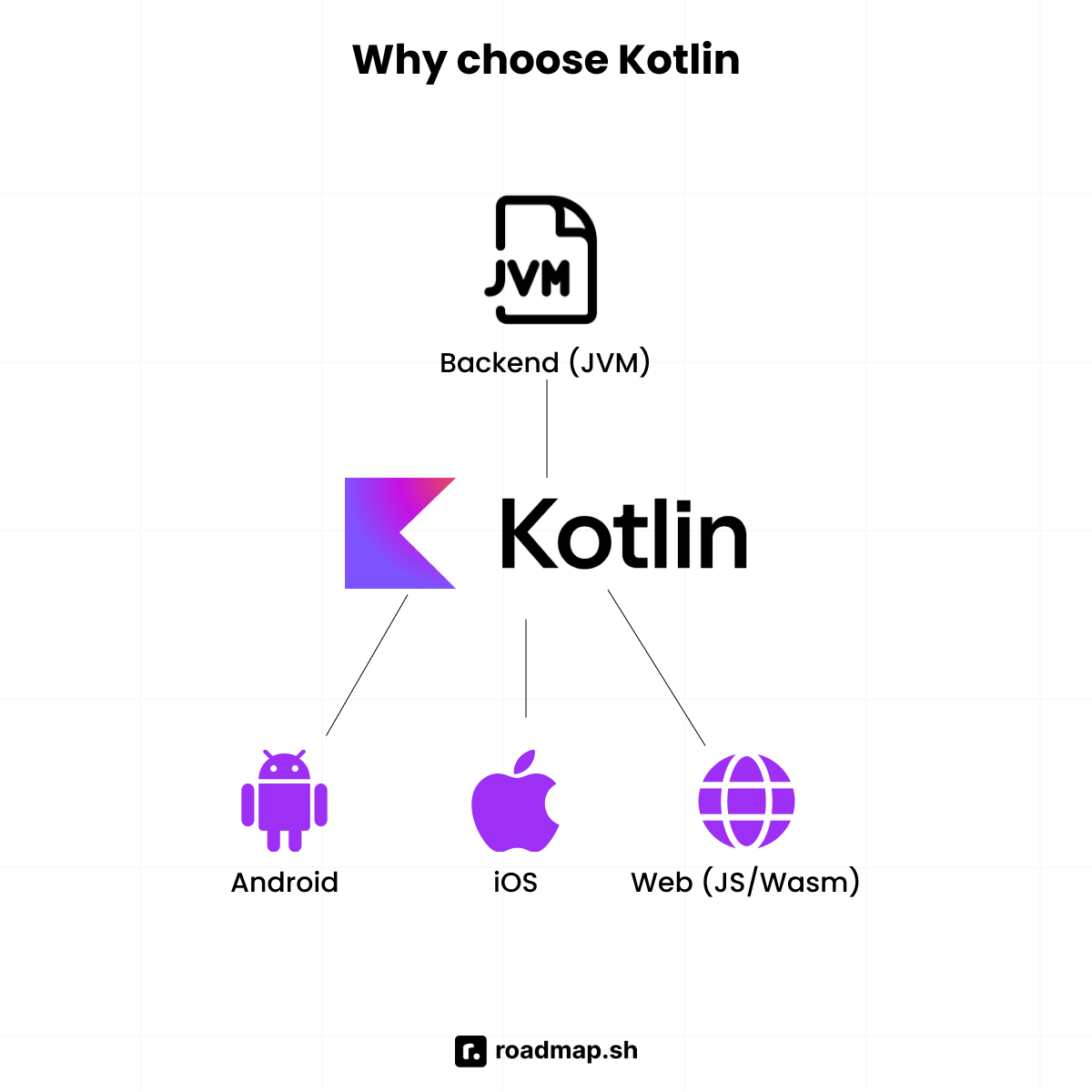
Here’s why you should adopt Kotlin in your tech stack in 2026:
Modern and expressive syntax
One of Kotlin’s biggest advantages is how much less code you need to write to get things done. It removes the boilerplate that clutters Java code, so you don’t have to manually declare endless getters, setters, and verbose constructors. This means you can focus more on solving problems and less on managing syntax. The result is clean, readable, and maintainable code that’s easier to work with.
Null safety
One of the most common issues in Java is the infamous NullPointerException. Kotlin solves this by building null safety directly into the language. Nullable and non-nullable types are clearly defined at compile time, preventing crashes before they happen. This adds a major layer of stability, especially for large-scale projects.
Interoperability with Java
If you’re wondering how Kotlin fits into an existing Java codebase, the answer is seamlessly. Kotlin was designed to work hand in hand with Java. You can call Java code from Kotlin without breaking your project. This makes Kotlin ideal if you’re migrating gradually or want to modernize parts of your system without a full rewrite.
Plus, Kotlin has full access to Java’s ecosystem of libraries, frameworks, and tools, giving you the best of both worlds.
Cross-platform capabilities
Kotlin is no longer limited to Android development. With Kotlin Multiplatform (KMP), you can share code across Android, iOS, desktop, web, and backend projects. This unified approach lets you reuse core logic across platforms, accelerate development cycles, and cut down on duplicated work, all while keeping a consistent experience for your users.
Coroutines and async programming
While modern Java now supports lightweight virtual threads, Kotlin takes asynchronous programming even further with coroutines built right into the language. Coroutines let you write non-blocking, asynchronous code that looks and feels like regular, sequential code. Kotlin's approach also includes structured concurrency, which helps organize and control the lifecycle of coroutines, resulting in clearer and more maintainable asynchronous code. This makes it simpler to manage tasks like network calls, database operations, and data-heavy processing.
Beyond the points above, Kotlin also has many practical use cases across different industries. For example:
Pinterest migrated its Android app to Kotlin and saw immediate improvement.
Allegro, one of Europe’s largest e-commerce platforms, uses Kotlin heavily in building its microservices.
N26, a mobile banking application, built its entire backend services with Kotlin, which makes it ideal for building financial services applications.
JetBrains, the creator of Kotlin, now uses Kotlin to share logic across its Android, iOS, and web development.
Now that we’ve explored the main reasons to choose Java or Kotlin, let’s take things a step further. How do these two languages actually differ in practice, and what makes each one stand out in practice? Let’s find out next.
Java vs. Kotlin: Key differences
Below are the key points to keep in mind when comparing Java and Kotlin for your next project:
Syntax and verbosity
The most noticeable difference between Java and Kotlin is how much code you need to write. Java is explicit, requiring you to declare types, boilerplate methods, and handle many details manually. Kotlin, on the other hand, is known for its concise syntax, which offers shortcuts for common patterns and automatically infers types in most cases.
For example, declaring a simple Person class in Java requires a lot of setup:
In Kotlin code, you can achieve the same result in one line using a data class:
Both versions perform the same function, but the Kotlin version is shorter, cleaner, and reduces the likelihood of errors. Kotlin also allows the use of secondary constructors, which can be defined alongside the primary constructor within the class body. This provides flexibility for different initialization scenarios when creating class instances.
Functional programming
Both Kotlin and Java support functional programming concepts, but Kotlin makes it feel more natural. In Java, functional features often feel like an add-on rather than a core design choice.
Kotlin treats functions as first-class citizens, meaning you can pass them as parameters, return them from other functions, or store them in variables. This makes it ideal when you’re building reactive systems, data pipelines, or modern APIs that rely heavily on mapping, filtering, and transforming data using functional patterns.
Concurrency model
Java relies on threads for concurrency, which means you have to manually manage threads, handle synchronization, and write more boilerplate code to run asynchronous tasks.
Kotlin takes a different approach. It introduces coroutines, which let you suspend and resume operations without blocking threads. This makes asynchronous programming simpler and yields more readable code. Tasks like network requests or database queries become easier to manage without the need for complex thread handling.
Ecosystem and community
Java’s ecosystem is massive and has been evolving for nearly three decades. It has libraries, frameworks, and tools for almost any use case imaginable. The community continues to grow, with developers consistently contributing to open-source projects that make Java even better.
Kotlin’s ecosystem is younger but expanding quickly. Backed by Google and JetBrains, it’s tightly integrated into modern development workflows, especially in Android, backend, and cross-platform projects. Kotlin can also call Java code directly, letting you take full advantage of Java’s existing ecosystem while enjoying Kotlin’s modern features.
Performance
Both run on the JVM, so performance is similar. However, Java has had a decade of optimization with the JVM, which gives it an edge over Kotlin. The garbage collector, JIT, and other experimental works like Project Valhalla have helped Java run applications faster.
Kotlin also compiles down to the same bytecode as Java, which makes it run as fast as Java in most cases. While modern software development features like lambda expressions, string templates, data classes, and coroutines make writing functional code easy, they may also affect performance if misused.
Which language should you learn?
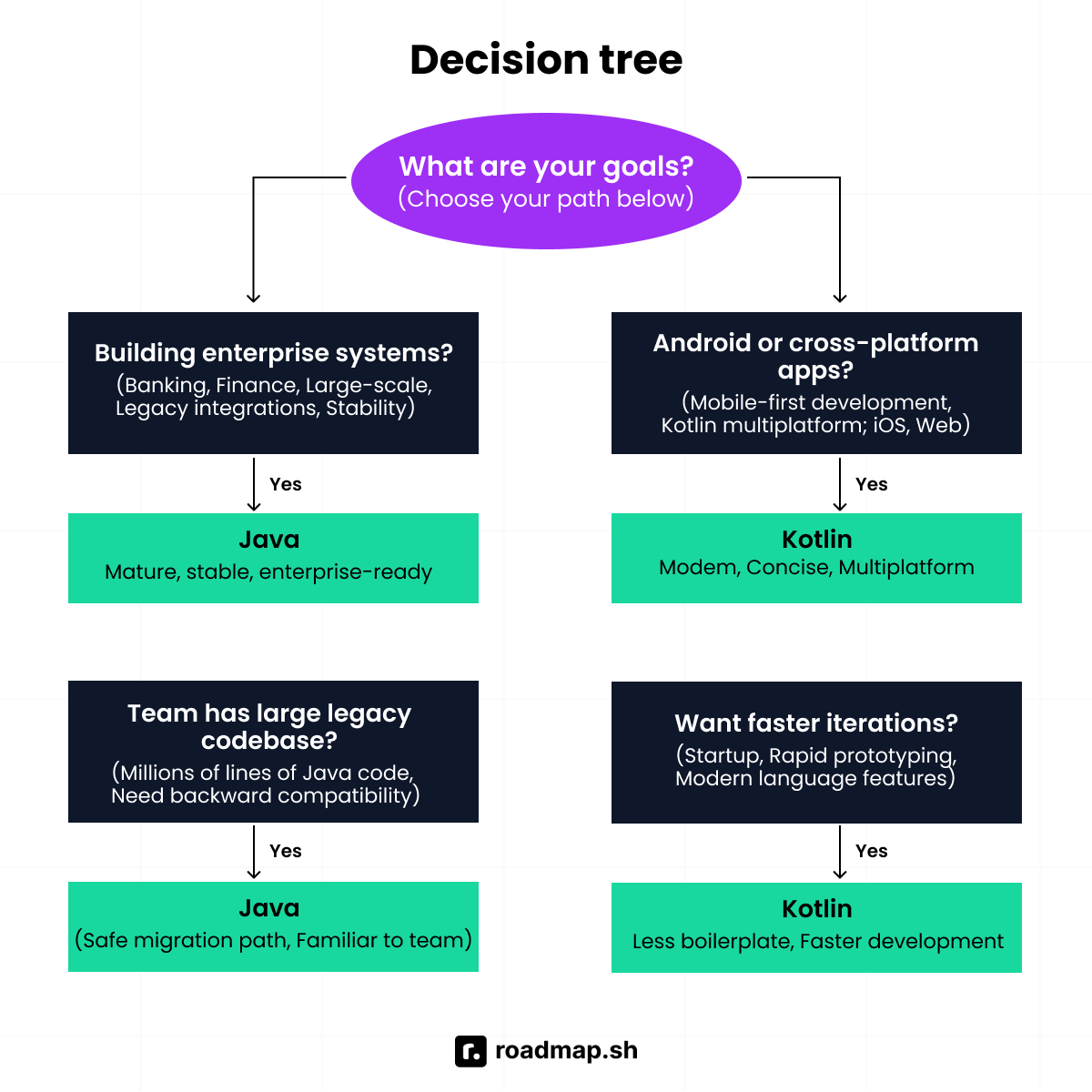
Choosing between Java and Kotlin depends entirely on context. Although they have the same roots, they branch out in different directions. So when it comes down to picking one, the decision depends on the following:
Project requirements
This is where it all starts. If you’re building large-scale enterprise applications like banking, government, or insurance systems, go for Java. It’s stable, battle-tested, and supports mission-critical workloads.
But if your project leans towards modern mobile, web, or cross-platform applications, Kotlin is a better choice. It offers features that make development faster and less prone to errors.
Team dynamics
Your team’s experience matters as much as the language itself. If your team has Java developers who have spent years working with Java, switching to Kotlin might require a mindset shift that slows progress at first. Teams with mixed experience levels will benefit from Java’s familiar syntax and extensive documentation.
On the other hand, if your team is relatively new and values clean code, functional programming, and rapid iteration, Kotlin is the better choice. With less boilerplate and a modern syntax, your team can move faster and ship with fewer bugs.
Long-term maintenance
Writing code is the easy part; maintaining it for the next years is the challenging part. Java’s biggest strength is its backward compatibility. Thanks to its LTS model, code written in Java 8 can still run on the latest JVM without breaking changes. That reliability makes it ideal for long-term projects.
Unlike Java, Kotlin has a younger ecosystem, but it’s also evolving quickly. While Java wins in historical stability, Kotlin wins in maintainability of new codebases.
Career goals and salary consideration
Java remains one of the most in-demand programming languages worldwide. Its popularity among both enterprises and smaller companies makes it a safe bet if you’re focused on job opportunities in fields like finance, cloud infrastructure, and enterprise IT.
Kotlin is also a strong option, especially with startups and mobile-first companies that value modern development practices and cross-platform solutions.
Use this simple framework to decide which language best fits your goals:
Question | If Yes, Choose Java | If Yes, Choose Kotlin |
Is your team maintaining legacy or enterprise systems? | ✔ | ✖ |
Are you building Android apps or modern mobile-first products? | ✖ | ✔ |
Do you prioritize long-term stability and support? | ✔ | ✖ |
Do you want concise, expressive, and modern syntax? | ✖ | ✔ |
Are you exploring cross-platform or multi-target development? | ✖ | ✔ |
Do you rely on existing enterprise frameworks or LTS releases? | ✔ | ✖ |
Wrapping up
There’s no universal winner in the Java vs. Kotlin debate; they're complementary tools in modern software engineering.
Java delivers unmatched stability, ecosystem maturity, and universal adoption that make it the safe choice for enterprise systems. Its predictable LTS cycles and massive developer community remove uncertainty from long-term projects.
Kotlin shines in modern, agile environments where productivity, safety, and code clarity matter most. The null values safety, concise syntax, and powerful coroutines make you more productive while catching bugs earlier.
Both languages will continue to evolve together, supported by the same JVM foundation. The smartest choice depends on your project’s goals, your team’s experience, and your long-term tech vision.
Ready to go deeper? Check out the Java roadmap and Kotlin roadmap for structured learning paths. Want personalized guidance as you learn? Try the AI tutor to get real-time help with concepts, code reviews, and project advice tailored to your learning style.
