C# vs C++: Which is Best for You in 2026?
 Ekene Eze
Choosing between C# and C++ starts with understanding the engineering trade-offs involved. Developers and technical teams compare these two programming languages when deciding how to approach software development across different platforms.
This guide breaks down the differences clearly so you can evaluate which object-oriented programming language best aligns with your project goals, team experience, memory management needs, and long-term application development plans.
TL;DR: C# vs. C++
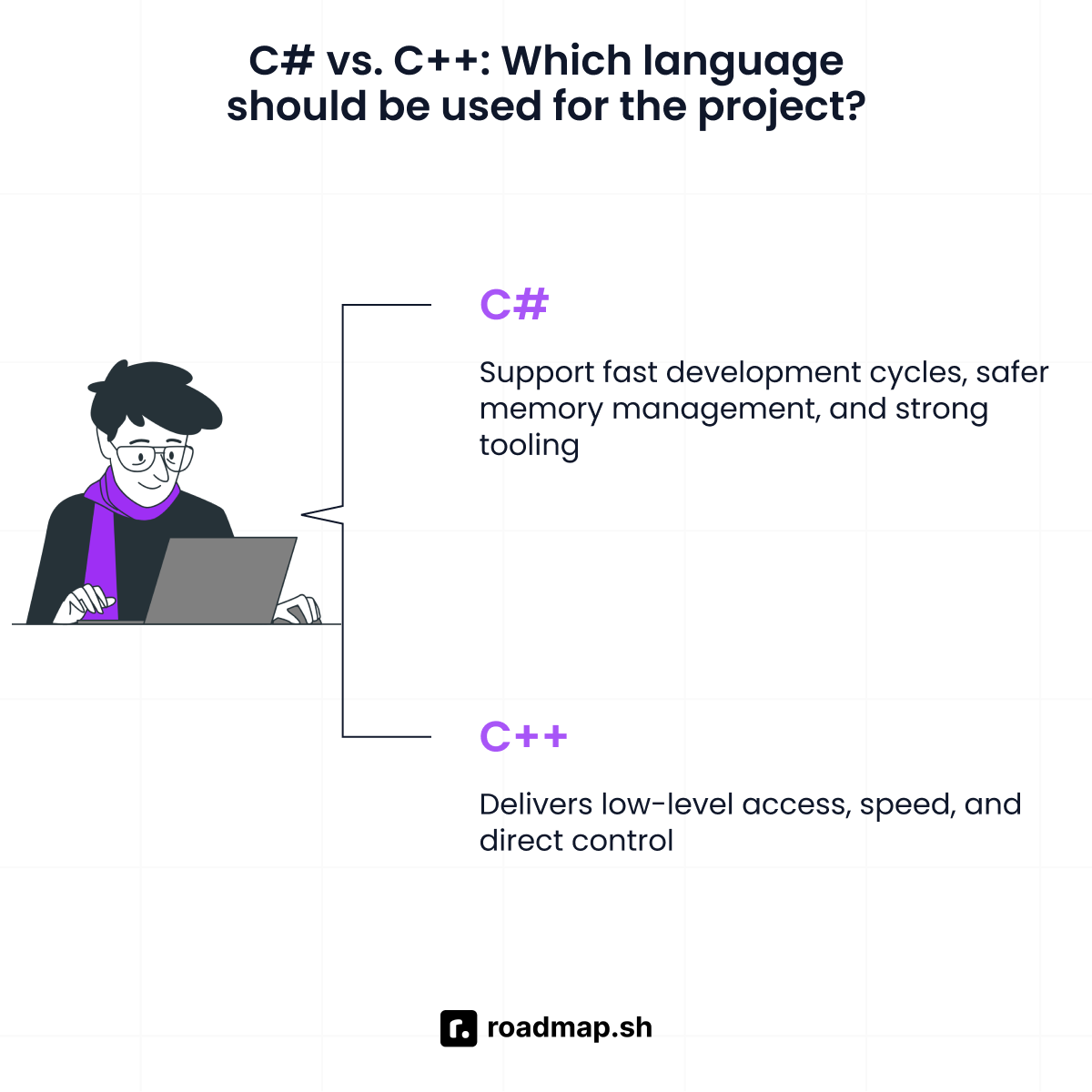
Every project has its own requirements, and these two programming languages take different approaches to solving the same problems. C# supports fast development cycles, safer memory management, and strong tooling. C++, on the other hand, delivers low-level access, speed, and direct control. The bullets below give you the quick answer before the guide explains each trade-off in detail.
Go for C# if…
C# lets teams develop apps faster due to strong IDE support and dependable tools.
Many developers use C# for web development, cloud services on Azure, and cross-platform business software.
The .NET Framework and modern .NET Core come with extensive libraries, structured data tools, and advanced features.
Automatic memory management through the garbage collector reduces manual work and avoids unsafe code paths.
Exception handling, runtime diagnostics, and predictable control flow help developers handle errors without digging into low-level programming.
Large groups can work in the same codebase with similar code patterns, object-oriented programming language features, and clean source code organization.
C# projects run on Windows, Linux, and macOS through the .NET runtime, making deployment more consistent and straightforward across platforms.
Integrated testing tools, language-integrated query (LINQ), and well-structured class program models support efficient software development.
Go for C++ if…
Many developers choose C++ for smart devices, robotics hardware, and device drivers because of strict memory limits and precise timing needs.
Studios rely on C++ for video game programming, custom engines, and simulation tools where every frame and instruction matters.
C++ lets programmers work with pointers, assembly code segments, and direct control flow that interacts closely with the operating system.
A compiled language like C++ produces predictable, deterministic performance across different environments and hardware.
Some projects depend on very fast response times and precise timing. C++ lets you manage memory directly and avoid garbage collection delays, making it a strong fit for real-time trading, robotics, and high-speed analysis tools.
C++ runs across Microsoft Windows, Linux, macOS, and specialized boards without a heavy runtime or managed code layer.
C++ supports both a procedural programming language approach and object-oriented programming for large, complex modules.
Many developers define functions, inspect source code directly, and work with raw pointers when they need full control over devices and structured data.
The C++ roadmap includes templates, memory models, concurrency, low-level programming, and other advanced topics for long-term growth.
If you want a structured path for learning C++, you can explore the full C++ developer roadmap.
C++ vs. C#: Comparison table
Here’s a quick overview of the trade-offs between the two languages.
Category | C# | C++ |
Productivity | Fast development, strong tooling, easier debugging | Slower dev cycles, more complex syntax |
Performance | High but not bare-metal | Maximum performance, hardware-level control |
Memory | Garbage-collected | Manual memory management |
Safety | Safer by default | Powerful but riskier |
Tooling | Excellent Windows & cross-platform IDEs | Broad but less unified |
Runtime | .NET runtime | Native machine code |
Deployment | Simple cross-platform runtime | Highly flexible across platforms |
Difficulty to learn | Easier for beginners due to consistent patterns | Steeper learning curve |
Why choose C#?
C# stands out as a powerful programming language used across industries. It balances ease of use with strong system control. That balance alone makes it a smart choice. But the real value becomes clearer when you look at the key reasons below.
A true object-oriented language for clean code
To begin with, C# is a fully object-oriented language. This means your program is built using objects, classes, and structured logic instead of scattered lines of code. As a result, large applications stay clean and easy to manage. Developers can reuse functions, organize systems better, and reduce errors. This structure also helps new programmers understand programming faster.
Higher-level language with smart memory handling
While C# gives you a lot of control, it still behaves like a higher-level language. For most tasks, you do not need to manage raw memory by hand because the runtime and garbage collector handle allocation and cleanup for you. This reduces common bugs such as memory leaks and random crashes, which makes your programs safer and more stable than code written fully in low-level languages.
When you need low-level access for extra performance, C# still lets you work closer to the hardware, while keeping the overall complexity and memory safety risk lower than in many strict low-level programming languages.
Built for error handling and safe programming
As your program grows, mistakes become harder to track. This is where C# helps. It provides built-in tools to handle errors through structured exception handling. These tools help your code remain stable when something unexpected happens. Instead of failing abruptly, your program can recover more gracefully and continue running in a controlled way. This is important for enterprise systems, cloud platforms, and financial software.
Modern syntax with powerful built-in features
Moving forward, C# offers clean, readable syntax with many features for faster development. You get advanced functions, async processing, strong typing, and deep support for objects. This lets developers build complex systems with fewer bugs. Because the language keeps improving, C# continues to stay relevant for modern programming needs.
Highly portable with strong market demand
Earlier, C# was mostly limited to Windows. Today, it is highly portable. You can run the same program on Windows, Linux, and macOS. This portability creates more job opportunities and attracts many developers worldwide. From mobile apps to cloud platforms and games, the same language powers everything.
Strong alternative to Java with better system control
When you work in Microsoft environments, C# is a natural alternative to Java. Both are popular programming languages with mature runtimes, but C# is designed to fit closely with Windows, the .NET ecosystem, and Azure services. Many teams find that this tight integration, combined with rich tooling in Visual Studio and related IDEs, can speed up development for desktop, cloud, and enterprise applications on Microsoft platforms.
Why choose C++?
C++ is one of the most respected programming languages in software history. It gives direct control over code, performance, and system resources. Unlike many modern tools, it works close to the machine while still supporting object-oriented design. That rare mix is exactly why many programmers still rely on it today.
Let’s break down the real reasons:
Low-level power with high-level structure
To start with, C++ operates at a low level, which means it gives you direct control over system memory, execution speed, and hardware interaction. At the same time, it is fully object-oriented, so you can design large systems using objects, classes, and reusable functions. This balance between structure and performance is something few languages offer.
The foundation of operating systems and system software
Once you understand its low-level control, the next reason becomes obvious. C++ plays a major role in building operating system components, hardware drivers, and performance-critical tools. Because it runs so close to the machine, it is trusted for writing system-level programs where stability and speed matter most.
The core of game development and video game programming
Now let’s move into one of the strongest use cases. C++ dominates game development and video game programming. Game engines, physics systems, graphics rendering, and real-time simulations depend on fast and optimized code. Most major engines rely on C++ because it delivers the speed that modern video games demand.
Object-oriented evolution from the C programming language
To see C++ clearly, it helps to understand the difference between C and C++. The original C language is a powerful procedural programming language that runs close to the hardware and is used for operating systems, embedded devices, and other low-level system software.
C++ evolved from the C programming language by adding object-oriented features, advanced syntax, and reusable objects. This evolution allows developers to write cleaner, larger, and more maintainable programs.
Cleaner syntax and strong control over functions
As systems grow, syntax clarity becomes critical. C++ supports advanced functions, templates, and strong type control. This makes programming safer and more predictable. Unlike purely high-level tools, C++ lets you decide how every part of your program behaves at runtime.
C# vs. C++: Key differences
Below are the differences that matter most when choosing between the two languages.
Performance
C# delivers strong performance for most business applications, cloud APIs, and desktop tools. It runs on a managed runtime with JIT or tiered compilation, which gives you good throughput and optimizations during execution. C++ typically reaches higher performance because it compiles to a native ahead-of-time binary that runs without a managed runtime and interacts more directly with hardware and system resources.
Choose C++ if you’re building systems where timing, device access, or frame-by-frame precision is essential. Choose C# for applications where development speed and reliable throughput matter more than microsecond accuracy.
Memory management
C# uses automatic garbage collection, which simplifies development and reduces common memory bugs. On the other hand, C++ gives developers full control through manual memory management, custom allocators, and precise ownership rules.
If memory safety and ease of maintenance are priorities, C# is more suitable, but if memory layout and deterministic allocation matter, C++ is the better match.
Safety
C# is safer by default because its managed runtime enforces type and bounds checks, manages memory automatically, and provides consistent exception handling behavior. C++ removes these limits and allows low-level operations, including pointer arithmetic and direct hardware access, which increases power but also increases the chance of errors.
Tooling and development experience
C# benefits from tooling, especially inside Visual Studio and JetBrains Rider. Building pipelines, debugging flows, and project templates are highly standardized. C++ has broad tooling support, but workflows differ across compilers (GCC, Clang, MSVC) and build systems (CMake, Ninja), making the ecosystem more flexible but less unified.
Difficulty to learn
C# is generally easier for beginners because patterns are consistent, and memory is handled automatically, while C++ has a steeper learning curve due to manual resource management, templates, and hardware-level concepts.
Which language should you learn? Decision framework

Long-term work depends on how clearly a team understands the system and how confidently new developers step into the codebase.
Every programming language shapes these day-to-day realities differently, especially once the project grows beyond early prototypes. C# and C++ each bring their own rhythm to maintenance, onboarding, and overall stability.
C# supports large teams through predictable structures, consistent class patterns, and the steady behavior of the .NET Core. Developers work inside an object-oriented language where modules follow familiar shapes, and memory behavior stays manageable. When the system needs frequent updates, many developers prefer this approach because the C# programming language limits how many low-level decisions they must track.
Your choice depends on the kind of software you want to build and the type of engineering challenges you enjoy working on.
Learn C# if you want to build:
Large-scale web applications, APIs, and backend services for fintech, health, government, or enterprise systems
Cloud applications, especially those built on Azure
Cross-platform desktop or business applications using .NET
Internal tools where reliability, maintainability, and clear structure matter
Projects with large or distributed teams, where consistent patterns reduce onboarding time
Learn C++ if you want to build:
Game engines, rendering tools, or high-performance simulations
Embedded systems, IoT devices, robotics controllers, and low-level firmware, where C is typically the primary language.
Real-time trading systems, scientific tools, or applications where microseconds matter
Software that interacts directly with hardware, memory layouts, or system resources
Long-running infrastructure components such as storage engines, custom caches, or networking layers
What’s next?
C# and C++ guide projects in different ways, and the best choice depends on how your team balances speed, control, and long-term maintenance.
C# supports fast development, organized structure, and clear behavior across large systems. C++ as an object-oriented language remains valuable when timing, hardware access, and predictable performance matter more than convenience.
These differences help teams decide which programming language matches their goals and which development path supports the system’s future growth.
As you plan your next build, look at the performance targets you have, the platforms you need to support, and the experience your team brings to the codebase. These factors usually highlight the C language that fits naturally.
For structured next steps, explore the complete roadmap catalog. Each tool helps you map out your learning, plan your project direction, and gain clarity on the skills you want to grow.
